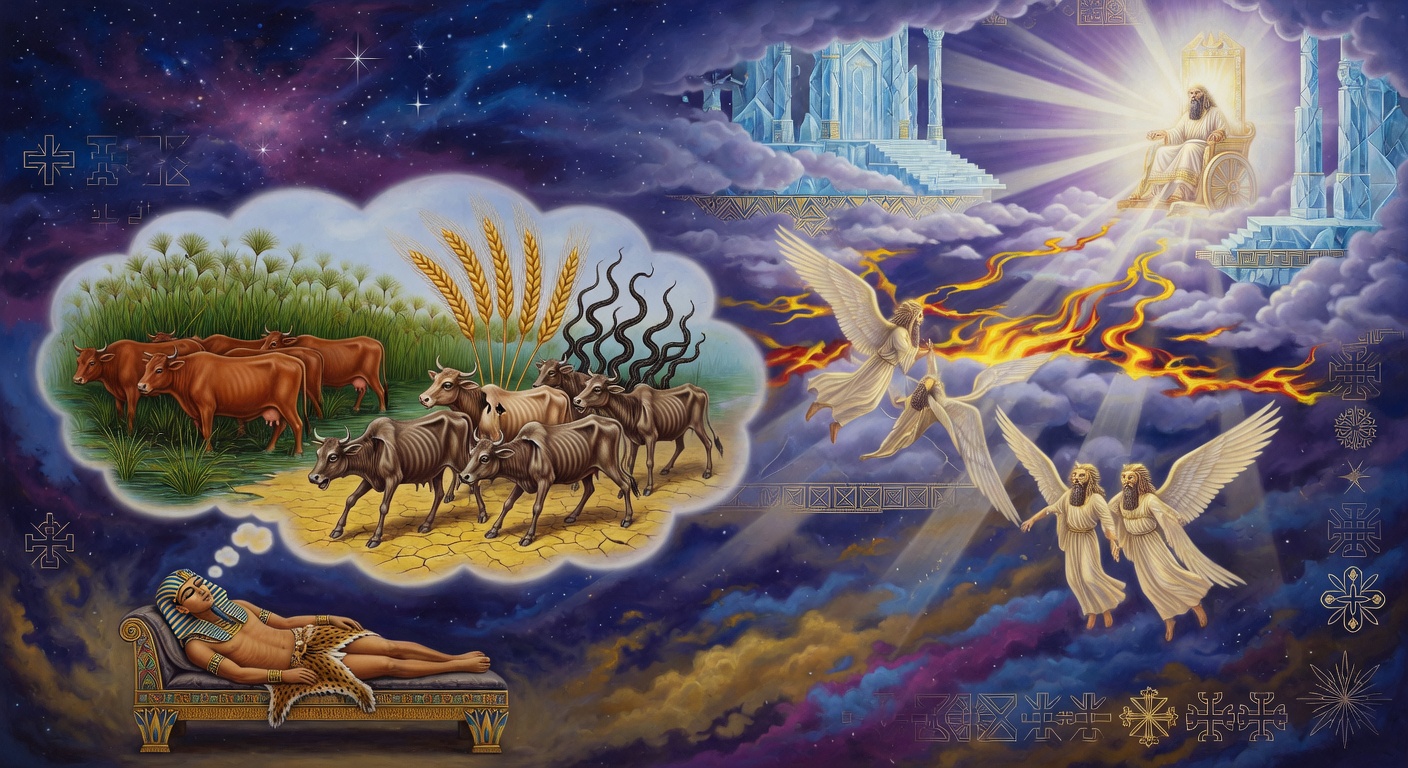
Pharaoh's Dreams are the paired visions of seven fat cows devoured by seven lean ones, and seven full ears consumed by seven withered ones - divine revelation of fourteen years of Egypt's economic future.
Among the visionary experiences recounted in the apocryphal expansions of the patriarchal narratives, dreams serve as divine instruments for unveiling future events and guiding the course of history. The Book of Jubilees, in its retelling of Genesis, integrates these nocturnal revelations into a structured chronology of world events divided into jubilees, emphasizing how such dreams align with the predetermined order of times and seasons. Similarly, the Book of Jasher elaborates on these episodes with additional narrative detail, portraying them as pivotal moments that connect individual fates to larger cosmic designs reminiscent of the revelatory traditions found in 1 Enoch.
In Jubilees 40, the account describes Pharaoh beholding seven robust cows consumed by seven emaciated ones, followed by seven full ears of grain swallowed by seven withered ones, events that Joseph deciphers as portents of seven years of agricultural abundance succeeded by seven of severe scarcity. The Book of Jasher, particularly in chapters 47 and 48, expands this sequence by noting the emotional turmoil of the ruler and the precise timing of the interpretation, underscoring Joseph's role as an intermediary who receives insight through wisdom granted from above. These passages remain faithful to the symbolic structure while framing the dreams within a theological context where heavenly knowledge intervenes to preserve life during periods of judgment.
The significance of these visions extends beyond their immediate historical setting to illuminate broader themes in the Enochian and related pseudepigraphal literature, where dreams function as coded messages about divine sovereignty over nations and natural cycles. They parallel the symbolic interpretations in 1 Enoch, such as the animal visions in the Apocalypse of Weeks, by demonstrating how apparent disasters form part of an ordered plan that ultimately leads to restoration and elevation for the righteous. For readers engaging these texts, the dreams highlight the interplay between human agency and predestined outcomes, offering insight into how ancient Jewish writers wove apocalyptic foresight into the stories of Israel's ancestors.
In those days, after the death of Isaac, the Lord commanded and caused a famine upon the whole earth....
I1n those days, after the death of Isaac, the Lord commanded and caused a famine upon the whole earth.
2 At that time Pharaoh king of Egypt was sitting upon his throne in the land of Egypt, and lay in his bed and dreamed dreams, and Pharaoh saw in his dream that he was standing by the side of the river of Egypt.3 And whilst he was standing he saw and behold seven fat fleshed and well favored kine came up out of the river.4 And seven other kine, lean fleshed and ill favored, came up after them, and the seven ill favored ones swallowed up the well favored ones, and still their appearance was ill as at first.5 And he awoke, and he slept again and he dreamed a second time, and he saw and behold seven ears of corn came up upon one stalk, rank and good, and seven thin ears blasted with the east wind sprang, up after them, and the thin ears swallowed up the full ones, and Pharaoh awoke out of his dream.6 And in the morning the king remembered his dreams, and his spirit was sadly troubled on account of his dreams, and the king hastened and sent and called for all the magicians of Egypt, and the wise men, and they came and stood before Pharaoh.7 And the king said unto them, I have dreamed dreams, and there is none to interpret them; and they said unto the king, relate thy dreams to thy servants and let us hear them.8 And the king related his dreams to them, and they all answered and said with one voice to the king, may the king live forever; and this is the interpretation of thy dreams.9 The seven good kine which thou didst see denote seven daughters that will be born unto thee in the latter days, and the seven kine which thou sawest come up after them, and swallowed them up, are for a sign that the daughters which will be born unto thee will all die in the life-time of the king.10 And that which thou didst see in the second dream of seven full good ears of corn coming up upon one stalk, this is their interpretation, that thou wilt build unto thyself in the latter days seven cities throughout the land of Egypt; and that which thou sawest of the seven blasted ears of corn springing up after them and swallowing them up whilst thou didst behold them with thine eyes, is for a sign that the cities which thou wilt build will all be destroyed in the latter days, in the life-time of the king.11 And when they spoke these words the king did not incline his ear to their words, neither did he fix his heart upon them, for the king knew in his wisdom that they did not give a proper interpretation of the dreams; and when they had finished speaking before the king, the king answered them, saying, What is this thing that you have spoken unto me? surely you have uttered falsehood and spoken lies; therefore now give the proper interpretation of my dreams, that you may not die.12 And the king commanded after this, and he sent and called again for other wise men, and they came and stood before the king, and the king related his dreams to them, and they all answered him according to the first interpretation, and the king's anger was kindled and he was very wroth, and the king said unto them, Surely you speak lies and utter falsehood in what you have said.13 And the king commanded that a proclamation should be issued throughout the land of Egypt, saying, It is resolved by the king and his great men, that any wise man who knoweth and understandeth the interpretation of dreams, and will not come this day before the king, shall die.14 And the man that will declare unto the king the proper interpretation of his dreams, there shall be given unto him all that he will require from the king. And all the wise men of the land of Egypt came before the king, together with all the magicians and sorcerers that were in Egypt and in Goshen, in Rameses, in Tachpanches, in Zoar, and in all the places on the borders of Egypt, and they all stood before the king.15 And all the nobles and the princes, and the attendants belonging to the king, came together from all the cities of Egypt, and they all sat before the king, and the king related his dreams before the wise men, and the princes, and all that sat before the king were astonished at the vision.16 And all the wise men who were before the king were greatly divided in their interpretation of his dreams; some of them interpreted them to the king, saying, The seven good kine are seven kings, who from the king's issue will be raised over Egypt.17 And the seven bad kine are seven princes, who will stand up against them in the latter days and destroy them; and the seven ears of corn are the seven great princes belonging to Egypt, who will fall in the hands of the seven less powerful princes of their enemies, in the wars of our lord the king.18 And some of them interpreted to the king in this manner, saying, The seven good kine are the strong cities of Egypt, and the seven bad kine are the seven nations of the land of Canaan, who will come against the seven cities of Egypt in the latter days and destroy them.19 And that which thou sawest in the second dream, of seven good and bad ears of corn, is a sign that the government of Egypt will again return to thy seed as at first.20 And in his reign the people of the cities of Egypt will turn against the seven cities of Canaan who are stronger than they are, and will destroy them, and the government of Egypt will return to thy seed.
 1n those days, after the death of Isaac, the Lord commanded and caused a famine upon the whole earth.