New Moon / Rosh Chodesh
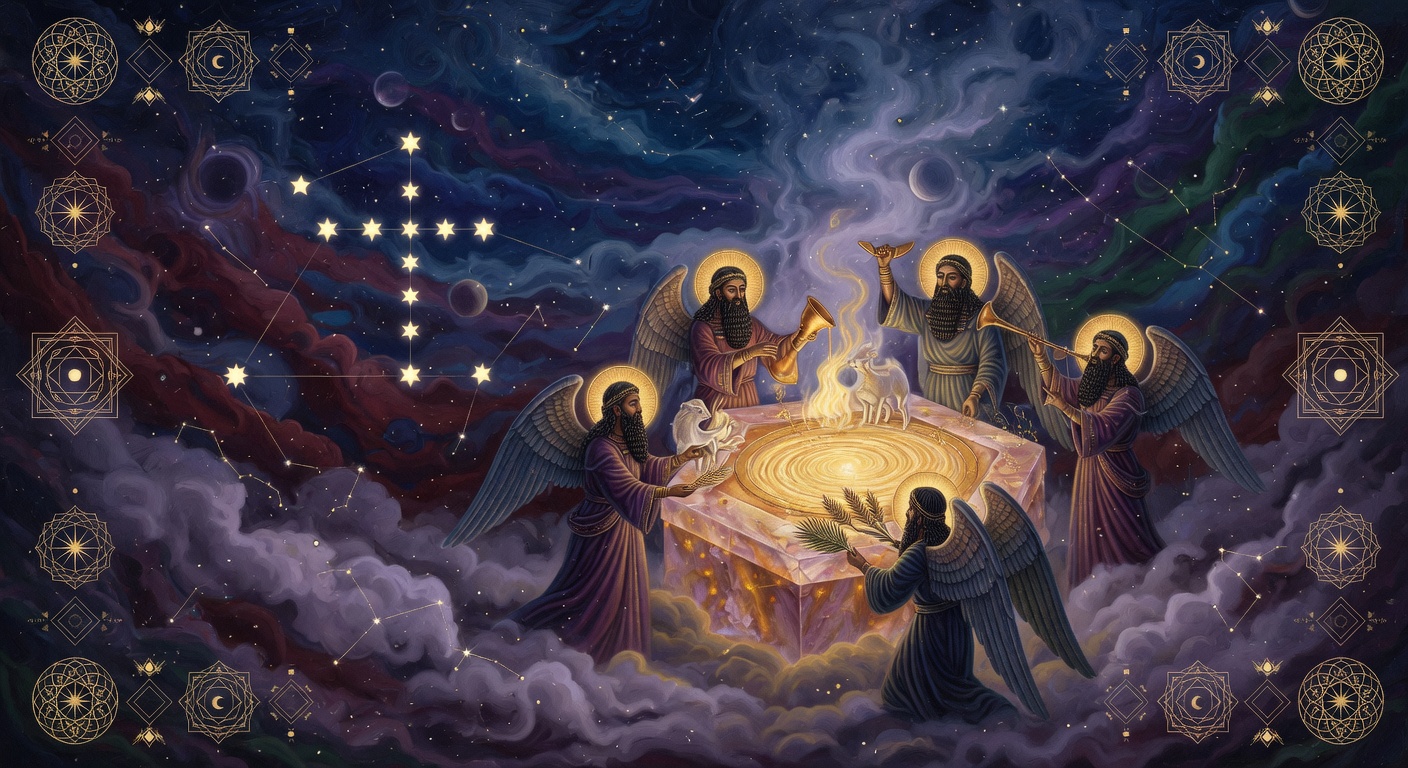
The New Moon (Rosh Chodesh) is the monthly observance marking the beginning of each thirty-day period - a fixed calendrical marker in the 364-day solar system with prescribed sacrifices. Within the ancient traditions preserved in these apocryphal works, the regular renewal of the lunar cycle served as a rhythmic marker of time that aligned human observance with the celestial order established at creation. These texts present the new moon not merely as an astronomical event but as an integral part of a divinely ordained system of reckoning days, seasons, and festivals. The emphasis falls on maintaining harmony between earthly worship and the movements of the luminaries, ensuring that sacrifices and commemorations occur at their appointed times without deviation. The Book of Jubilees develops this framework most explicitly through its account of a fixed solar calendar comprising 364 days, divided into four quarters of 91 days each. New moons are noted as boundary points within this structure, with the text insisting that festivals and offerings must follow the solar divisions rather than lunar variations. In Jubilees 6:23-32, the narrative of the flood covenant underscores this discipline, warning against any alteration of the appointed times and linking the new moon observances to the broader pattern of weekly and annual cycles that Noah received. Special sacrifices are prescribed at these intervals, reinforcing the idea that each month begins under a structured divine timetable rather than fluctuating observation. The Astronomical Book of 1 Enoch complements this perspective by detailing the precise mechanics of the sun and moon across chapters 72 through 82. Here the moon’s phases are described in relation to the sun’s unchanging path, with the new moon marking the moment when the two luminaries align at the start of each month. Enoch’s visions portray these conjunctions as part of an eternal order revealed to him by the angel Uriel, where the 364-day year remains perfectly balanced and free from the disruptions that lunar calendars introduce. This material underscores the Enochian concern for accuracy in tracking time, portraying the new moon as a visible sign within a larger, immutable system. Although the Book of Jasher offers fewer direct calendrical instructions, it situates similar observances within patriarchal narratives, presenting monthly commemorations as extensions of the covenantal practices handed down from Noah and the earlier generations. Together these writings portray the new moon as a recurring opportunity to reaffirm fidelity to the cosmic law, anchoring ritual life to the same heavenly patterns that govern the entire created order.
Details
- Category
- Monthly
- Timing
- 1st of each month
- Season
- Varies
Key Chapters
Key Passages
New Moon Offerings
The Book of Jubilees 6:23-38
And on the new moon of the first month, and on the new moon of the fourth month, and on the new moon of the seventh mont...
 23nd on the new moon of the first month, and on the new moon of the fourth month, and on the new moon of the seventh month, and on the new moon of the tenth month are the days of remembrance, and the days of the seasons in the four divisions of the year. These are written and ordained as a testimony for ever.
Did You Know?
The 364-day solar calendar of Jubilees uses new moons as fixed markers rather than observable events.
Special sacrifices were prescribed at each new moon to sanctify the beginning of every month.
The 364-day solar calendar makes new moons predictable markers rather than observed events.
Special sacrifices at each new moon sanctify the beginning of every thirty-day period.
The Astronomical Book of Enoch provides the mathematical framework that ensures new moons never drift.