Stars and Luminaries
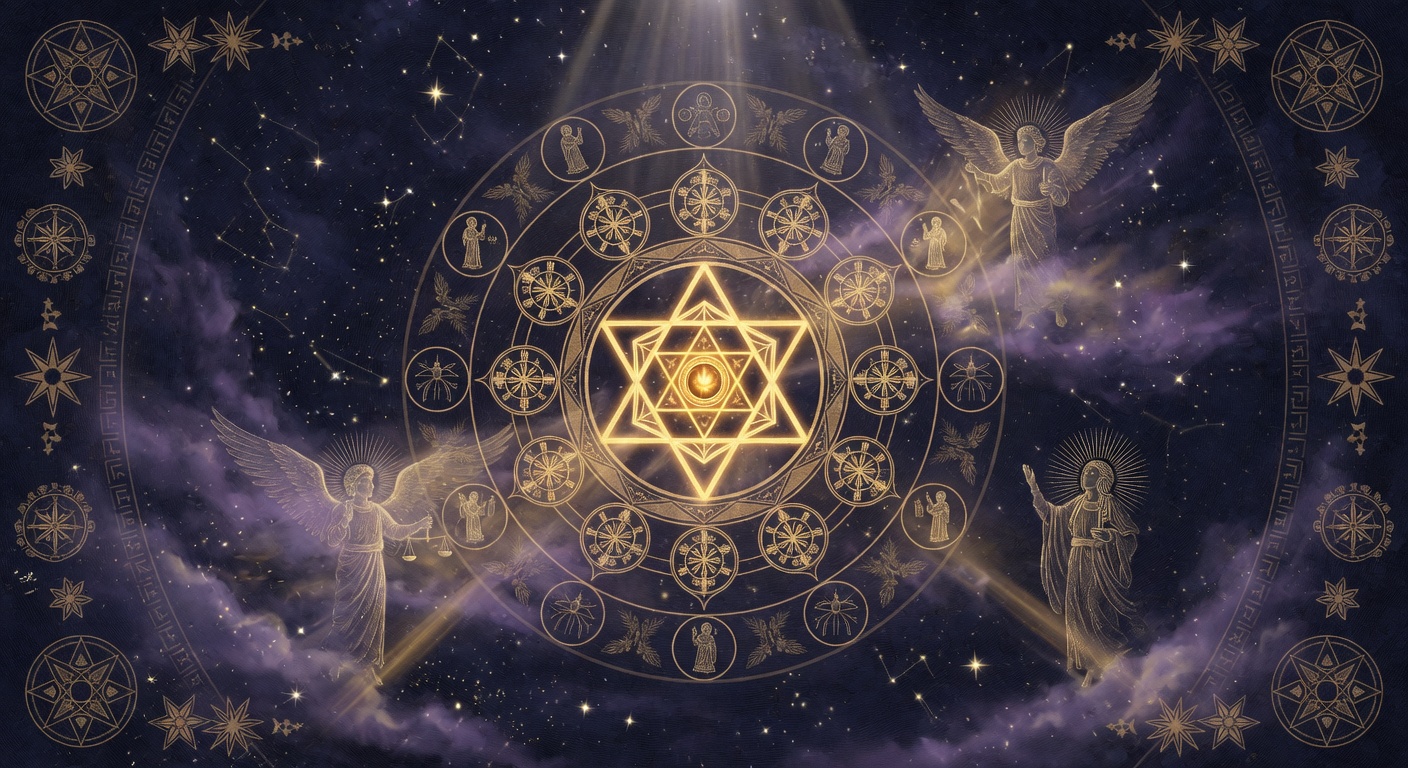
Stars and Luminaries in the Enochic tradition represent both the ordered cosmos and its moral hierarchy - faithful stars maintain their circuits while fallen stars (the Watchers) abandon their stations and face imprisonment. In the visionary cosmology of 1 Enoch, celestial bodies serve as living emblems of divine hierarchy and moral order, where the movements of stars and luminaries mirror the obedience or rebellion of heavenly beings. The text portrays the heavens not as inert space but as a structured realm in which these lights execute precise circuits established by the Creator, reflecting the same regularity expected of angels and the righteous alike. This symbolism emerges most vividly in the Book of Watchers and the later Animal Apocalypse, where the sky functions as a moral ledger recording fidelity or transgression. Specific passages ground this imagery in narrative detail. In 1 Enoch 86, stars descend from heaven and pasture among cattle, an allegory for the Watchers who abandon their stations to consort with human women, producing the giants whose violence corrupts the earth. Earlier chapters (18 and 21) describe imprisoned stars as the leaders of this revolt, bound in a chaotic realm beyond the ordered cosmos until the final judgment. By contrast, the righteous are depicted as stars that remain fixed in their appointed paths, shining eternally as a reward for fidelity. These images draw directly from Enoch’s heavenly journeys, which reveal both the punishment of wayward luminaries and the flawless circuits maintained by those who uphold divine law. The Astronomical Book (chapters 72-82) deepens this framework by presenting an elaborate account of solar, lunar, and stellar movements as revelations entrusted to Enoch himself. Here the luminaries follow gates and portals in exact ratios, their regularity serving as evidence of God’s sovereign design against any chaotic intrusion. Jubilees echoes this emphasis on calendrical precision, linking the proper reckoning of seasons and years to angelic instruction and covenant fidelity. Together these traditions present stars and luminaries as both witnesses to primordial order and cautionary figures whose deviation illustrates the consequences of abandoning one’s appointed station.
Details
- Symbolizes
- Angels, Righteous, and Cosmic Order
Key Chapters
Key Passages
Stars as Watchers
The Book of Enoch 86:1-6
And again I saw with mine eyes as I slept, and I saw the heaven above, and behold a star fell from heaven, and it arose ...
 1nd again I saw with mine eyes as I slept, and I saw the heaven above, and behold a star fell from heaven, and it arose and eat and pastured amongst those oxen.
Astronomical Book
The Book of Enoch 72:1-37
The book of the courses of the luminaries of the heaven, the relations of each, according to their classes, their domini...
 1he book of the courses of the luminaries of the heaven, the relations of each, according to their classes, their dominion and their seasons, according to their names and places of origin, and according to their months, which Uriel, the holy angel, who was with me, who is their guide, showed me; and he showed me all their laws exactly as they are, and how it is with regard to all the years of the world and unto eternity, till the new creation is accomplished which dureth till eternity.
Did You Know?
Fallen stars = the Watchers in Enoch's visions.
The righteous shine like stars in some interpretations.
Stars that leave their orbits represent angels who abandon their assigned stations - cosmic desertion.
The 364-day calendar depends on stellar regularity - astronomical faithfulness mirrors moral faithfulness.
In the Animal Apocalypse, falling stars descending among cattle depict the Watchers corrupting humanity.