Covenant and Eternal Law
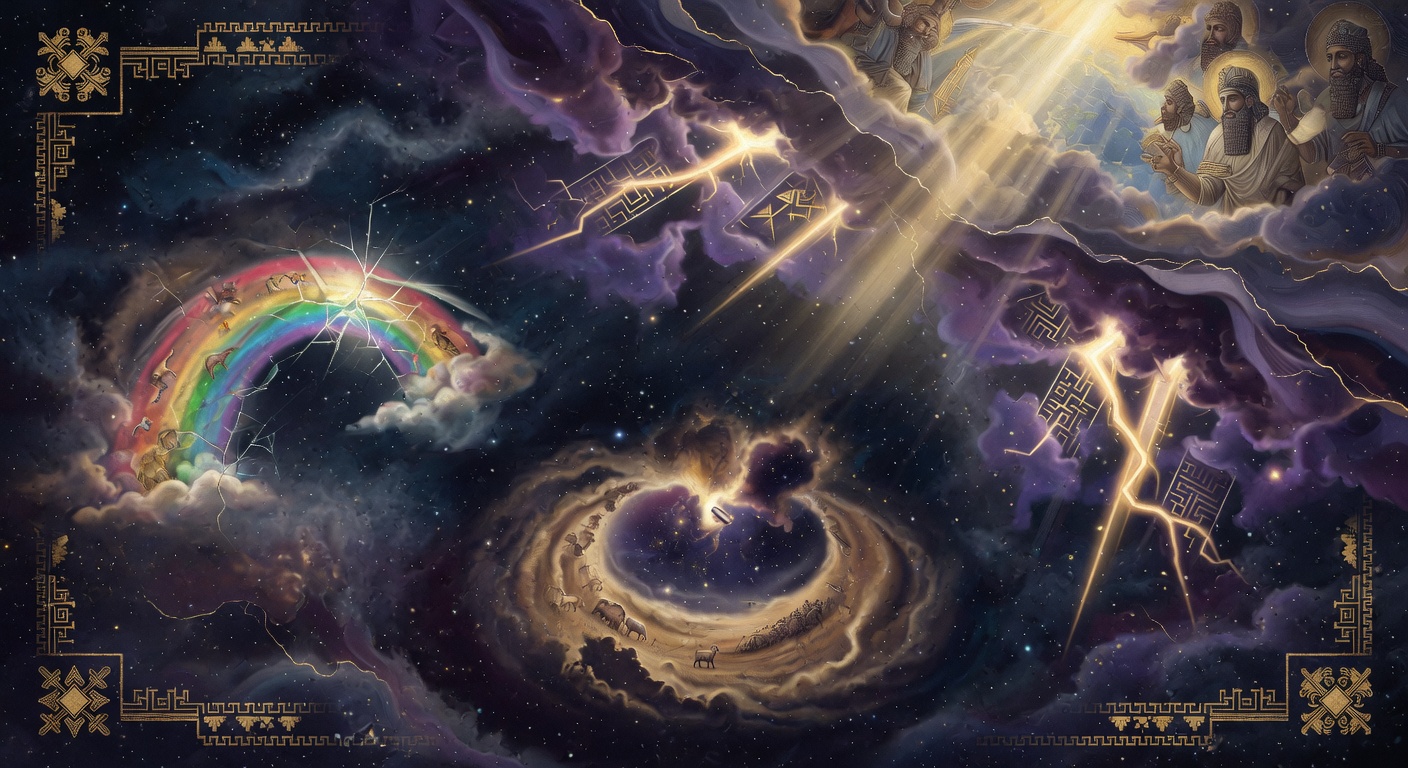
Covenant is the binding agreement between God and humanity that structures the entire narrative of these texts - from Noah through Abraham to Sinai, each sealed with visible signs and recorded on the heavenly tablets. In the ancient pseudepigraphal traditions, divine covenants function not merely as historical agreements but as expressions of an eternal order established at creation itself. These texts portray God's dealings with humanity as renewals of a primordial law that governs time, ethics, and cosmic stability, rather than innovations introduced at later moments of crisis. The narrative arc moves from the antediluvian period through the patriarchs to Sinai, presenting each covenant as a reaffirmation of statutes already inscribed in the heavenly tablets and operative since the first week of the world. The Book of Jubilees develops this theme with particular clarity by insisting that the calendar, festivals, and moral commandments predate the Flood. Noah receives the covenant of the rainbow in chapter 6 together with explicit instructions on the solar reckoning of 364 days, while Abraham's covenant in chapter 15 renews the same laws of circumcision and separation that had been observed by Enoch and Noah. Jubilees thereby frames the later revelation at Sinai as a restoration rather than an origin, emphasizing that Israel's fidelity to these written ordinances maintains the created order against the chaos introduced by the Watchers. First Enoch complements this perspective through its depiction of the heavenly tablets and the eternal laws entrusted to the patriarch, who records judgments that will stand until the final renewal of heaven and earth. Although Enoch does not narrate patriarchal covenants in detail, its portrayal of fixed celestial cycles and immutable decrees supplies the cosmological foundation that Jubilees later applies to Israel's legal tradition. The Book of Jasher, in turn, preserves narrative expansions of the patriarchal stories that underscore the continuity of these obligations across generations. Taken together, these writings present covenant and law as twin aspects of a single divine economy, one that begins before history and extends beyond it. Readers encounter a worldview in which Sinai completes what was already latent in creation, binding Israel to an order that angels and patriarchs alike were summoned to keep.
Details
- Category
- Covenantal
- Key Figures
- Noah, Abraham, Moses, Angel of the Presence
- Passages
- 5 key references
Key Chapters
Key Passages
Noahic and Abrahamic
The Book of Jubilees 6:1-17
And on the new moon of the third month he went forth from the ark, and built an altar on that mountain....
 1nd on the new moon of the third month he went forth from the ark, and built an altar on that mountain.
Circumcision covenant
The Book of Jubilees 15:1-14
And in the fifth year of the fourth week of this jubilee, 1979 A.M. in the third month, in the middle of the month, Abra...
1nd in the fifth year of the fourth week of this jubilee, 1979 A.M. in the third month, in the middle of the month, Abram celebrated the feast of the first-fruits of the grain harvest.
Sabbath covenant
The Book of Jubilees 2:17-33
And He gave us a great sign, the Sabbath day, that we should work six days, but keep Sabbath on the seventh day from all...
17nd He gave us a great sign, the Sabbath day, that we should work six days, but keep Sabbath on the seventh day from all work.
Abraham's covenant
The Book of Jubilees 14:1-20
After these things, in the fourth year of this week, on the new moon of the third month, the word of the Lord came to Ab...
1fter these things, in the fourth year of this week, on the new moon of the third month, the word of the Lord came to Abram in a dream, saying: 'Fear not, Abram; I am thy defender, and thy reward will be exceeding great.'
Covenant at Sinai
The Book of Jubilees 1:1-28
And it came to pass in the first year of the exodus of the children of Israel out of Egypt, in the third month, on the s...
1nd it came to pass in the first year of the exodus of the children of Israel out of Egypt, in the third month, on the sixteenth day of the month, 2450 Anno Mundi that God spake to Moses, saying: 'Come up to Me on the Mount, and I will give thee two tables of stone of the law and of the commandment, which I have written, that thou mayst teach them.'
Did You Know?
Jubilees presents covenants as eternal and already known before Sinai.
The calendar and feasts are part of the 'eternal' law.
Every major covenant in the tradition includes both a promise and a visible sign - never just words.
Jubilees presents covenants as pre-recorded on heavenly tablets - their terms exist before they're enacted.
The chain from Noah to Abraham to Sinai shows progressive narrowing: all flesh → one family → one nation.