Divine Judgment and the Flood
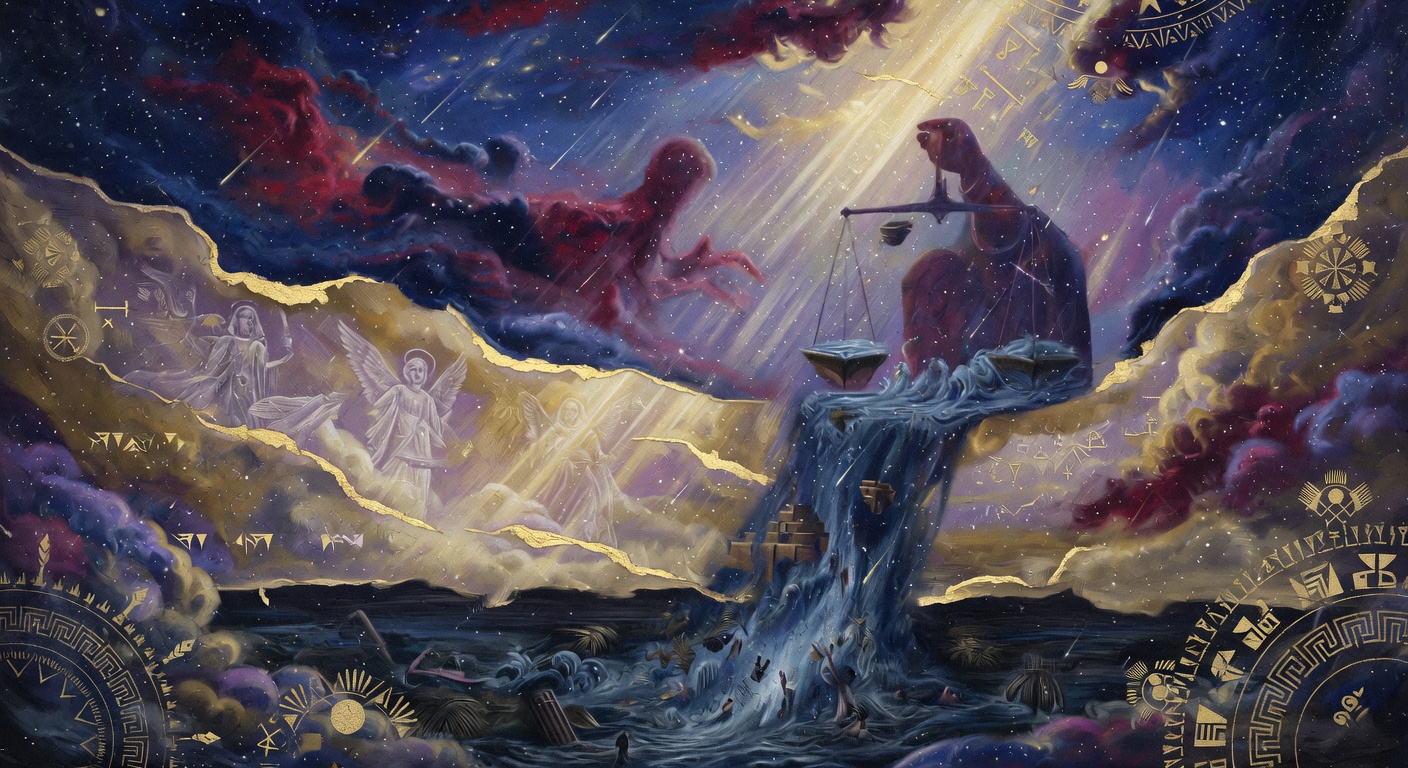
Judgment is the overarching theme of divine reckoning that pervades the Enochic tradition - the certainty that God will hold both angels and humans accountable for their deeds. In the ancient apocryphal traditions, the great deluge emerges as the decisive act of divine intervention against a world overrun by corruption that originated in heaven itself. The Watchers, a group of angels who descended to Mount Hermon, not only revealed forbidden arts such as weapon-making and cosmetics but also entered unions with human women, producing the violent and insatiable giants described in 1 Enoch 6-7. This transgression shattered the boundaries between the divine and human realms, filling the earth with blood and lawlessness that cried out for judgment. The Flood therefore functions less as a simple punishment for human sin and more as the necessary cleansing of a cosmos polluted by angelic rebellion. The Book of Enoch situates this judgment within a tightly structured heavenly decree. In chapters 10-11 the archangels receive explicit commands to bind the Watchers, destroy the giants, and spare only Noah, who is instructed to hide himself and preserve seed for a renewed creation. Later passages in chapters 65-67 and 106-107 expand the scene, portraying Noah’s righteous stand against the giants and the angels’ futile pleas for mercy. These narratives present the Flood as the moment when divine order is forcibly restored after the cosmic boundaries have been violated. The Book of Jubilees and the Book of Jasher develop the same sequence with additional chronological precision. Jubilees 5 recounts how the giants turned against one another and humanity before the waters were released in the 600th year of Noah’s life, while Jasher 4-5 supplies extended dialogue underscoring Noah’s repeated warnings and the people’s refusal to repent. Across these texts Noah stands as the single righteous remnant whose preservation guarantees both the continuation of the human line and the renewal of the covenantal relationship with God. Within the broader Enochian tradition this episode carries lasting theological weight. It demonstrates that divine justice operates on multiple levels-angelic, human, and cosmic-while establishing Noah as the model of fidelity amid universal collapse. The Flood thus becomes the archetype for all subsequent judgments, linking the primordial rebellion of the Watchers to the moral choices of later generations.
Details
- Category
- Eschatological
- Key Figures
- Noah, Enoch, The Watchers
- Passages
- 17 key references
Key Chapters
Key Passages
Judgment Pronounced
The Book of Enoch 10:1-15
Then said the Most High, the Holy and Great One spake, and sent Uriel to the son of Lamech, and said to him:...
 1hen said the Most High, the Holy and Great One spake, and sent Uriel to the son of Lamech, and said to him:
Sheol and the compartments of the dead
The Book of Enoch 22:1-14
And thence I went to another place, and he showed me in the west another great and high mountain and of hard rock. Etheo...
 1nd thence I went to another place, and he showed me in the west another great and high mountain and of hard rock. Etheopic Greek
Woes on the sinners
The Book of Enoch 94:1-11
And now I say unto you, my sons, love righteousness and walk therein; For the paths of righteousness are worthy of accep...
1nd now I say unto you, my sons, love righteousness and walk therein; For the paths of righteousness are worthy of acceptation, But the paths of unrighteousness shall suddenly be destroyed and vanish.
The final judgment of the shepherds
The Book of Enoch 90:20-27
And I saw till a throne was erected in the pleasant land, and the Lord of the sheep sat Himself thereon, and the other t...
20nd I saw till a throne was erected in the pleasant land, and the Lord of the sheep sat Himself thereon, and the other took the sealed books and opened those books before the Lord of the sheep.
Metal mountains melt before the Elect One
The Book of Enoch 52:1-9
And after those days in that place where I had seen all the visions of that which is hidden-for I had been carried off i...
1nd after those days in that place where I had seen all the visions of that which is hidden-for I had been carried off in a whirlwind and they had borne me towards the west.
The accursed valley
The Book of Enoch 27:1-5
Then said I: 'For what object is this blessed land, which is entirely filled with trees, and this accursed valley betwee...
1hen said I: 'For what object is this blessed land, which is entirely filled with trees, and this accursed valley between?'
Flood as judgment prototype
The Book of Enoch 54:7-10
And in those days shall punishment come from the Lord of Spirits, and he will open all the chambers of waters which are ...
7nd in those days shall punishment come from the Lord of Spirits, and he will open all the chambers of waters which are above the heavens, and of the fountains which are beneath the earth.
Terrors of the Day of Judgment
The Book of Enoch 102:1-11
In those days when He hath brought a grievous fire upon you, Whither will ye flee, and where will ye find deliverance ? ...
 1n those days when He hath brought a grievous fire upon you, Whither will ye flee, and where will ye find deliverance ? And when He launches forth His Word against you Will you not be affrighted and fear ?
Exhortation to fear God
The Book of Enoch 101:1-9
Observe the heaven, ye children of heaven, and every work of the Most High, and fear ye Him and work no evil in His pres...
 1bserve the heaven, ye children of heaven, and every work of the Most High, and fear ye Him and work no evil in His presence.
Grounds of hopefulness
The Book of Enoch 96:1-8
Be hopeful, ye righteous; for suddenly shall the sinners perish before you, And ye shall have lordship over them accordi...
 1e hopeful, ye righteous; for suddenly shall the sinners perish before you, And ye shall have lordship over them according to your desires.
Self-indulgence of sinners
The Book of Enoch 98:1-16
And now I swear unto you, to the wise and to the foolish, For ye shall have manifold experiences on the earth....
1nd now I swear unto you, to the wise and to the foolish, For ye shall have manifold experiences on the earth.
Woes on the godless
The Book of Enoch 99:1-16
Woe to you who work godlessness, And glory in lying and extol them: Ye shall perish, and no happy life shall be yours....
 1oe to you who work godlessness, And glory in lying and extol them: Ye shall perish, and no happy life shall be yours.
Imprisonment of fallen stars
The Book of Enoch 23:1-4
From thence I went to another place to the west of the ends of the earth....
 1rom thence I went to another place to the west of the ends of the earth.
The accursed valley detailed
The Book of Enoch 26:1-6
And I went from thence to the middle of the earth, and I saw a blessed place in which there were trees with branches abi...
1nd I went from thence to the middle of the earth, and I saw a blessed place in which there were trees with branches abiding and blooming of a dismembered tree.
Resurrection of the dead
The Book of Enoch 51:1-5
And in those days shall the earth also give back that which has been entrusted to it, And Sheol also shall give back tha...
1nd in those days shall the earth also give back that which has been entrusted to it, And Sheol also shall give back that which it has received, And hell shall give back that which it owes. 5a. For in those days the Elect One shall arise,
Valley of judgment
The Book of Enoch 53:1-7
There mine eyes saw a deep valley with open mouths, and all who dwell on the earth and sea and islands shall bring to hi...
1here mine eyes saw a deep valley with open mouths, and all who dwell on the earth and sea and islands shall bring to him gifts and presents and tokens of homage, but that deep valley shall not become full.
Introduction to Epistle
The Book of Enoch 92:1-5
The book written by Enoch-Enoch indeed wrote this complete doctrine of wisdom, (which is) praised of all men and a judge...
1he book written by Enoch-Enoch indeed wrote this complete doctrine of wisdom, (which is) praised of all men and a judge of all the earth for all my children who shall dwell on the earth. And for the future generations who shall observe uprightness and peace.
Did You Know?
The Flood is the first great judgment; the final one is still future in Enoch.
Both are carried out by divine agents (angels / Son of Man).
Judgment in Enoch is always precise: specific sentences for specific sins, never arbitrary.
The righteous witness the punishment of the wicked - vindication requires visibility.
Fire, darkness, and chains appear as recurring instruments - judgment has consistent vocabulary.