The Watchers and Their Fall
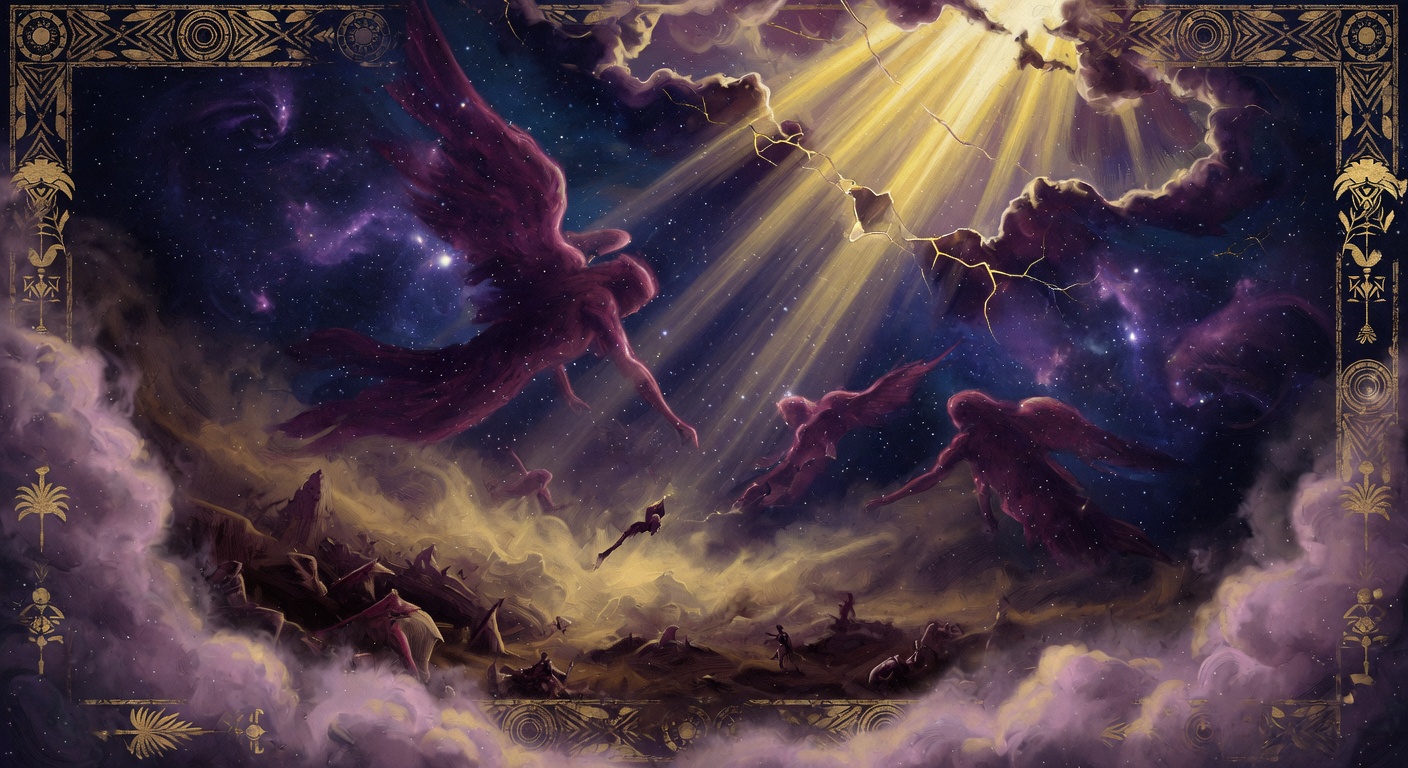
The Watchers are the rebellious angels who descended from heaven to earth, took human wives, and introduced forbidden knowledge that corrupted humanity before the Flood. In the ancient Jewish apocalyptic traditions, the narrative of rebellious angels descending to earth serves as a profound explanation for the origins of human corruption and the necessity of divine judgment. This account, preserved most fully in the Book of Enoch, portrays these heavenly beings as initially holy watchers assigned to oversee creation, yet their decision to abandon their proper station initiates a chain of events that fundamentally alters the moral order of the world. The story provides crucial context for the Flood as not merely punishment for human wickedness but as a response to a deeper cosmic transgression involving both celestial and terrestrial realms. Central to this tradition is the pact formed by two hundred angels under the leadership of Semjaza and Azazel on Mount Hermon, as detailed in 1 Enoch 6. Swearing a mutual oath to take human wives and share forbidden knowledge, they descend and beget the giants known as Nephilim. Their teachings encompass metallurgy for weapons and ornaments, the use of cosmetics and dyes, sorcery, and the secrets of the stars and clouds, as recorded in 1 Enoch 7-8. These revelations accelerate violence and idolatry among humanity, corrupting the natural boundaries established at creation. The Books of Jubilees and Jasher reinforce this framework while adding distinct emphases. Jubilees 5 describes the angels as Watchers who defile themselves with the daughters of men, producing offspring that fill the earth with lawlessness and prompt the divine decree of the Flood. Jasher similarly alludes to the angels' descent and the resulting moral decay in the generations before Noah. Together these texts position the angels' fall as the pivotal event that necessitates both the destruction of the old world and the renewal of the covenant with Noah's line. Within the broader Enochian tradition, this episode underscores the interplay between free will, divine order, and eschatological judgment. It frames subsequent revelations about the final binding of the fallen angels and the restoration of righteousness, offering readers a lens through which to interpret the persistence of evil and the hope of ultimate cosmic restoration.
Details
- Category
- Angelic / Primordial
- Key Figures
- The Watchers, Enoch, Noah
- Passages
- 9 key references
Key Chapters
Key Passages
Core Account
The Book of Enoch 6:1-8
And it came to pass when the children of men had multiplied that in those days were born unto them beautiful and comely ...
 1nd it came to pass when the children of men had multiplied that in those days were born unto them beautiful and comely daughters.
Watchers' forbidden teachings
The Book of Enoch 8:1-4
And Azazel taught men to make swords, and knives, and shields, and breastplates, and made known to them the metals of th...
1nd Azazel taught men to make swords, and knives, and shields, and breastplates, and made known to them the metals of the earth and the art of working them, and bracelets, and ornaments, and the use of antimony, and the beautifying of the eyelids, and all kinds of costly stones, and all colouring tinctures.
Archangels report to God
The Book of Enoch 9:1-11
And then Michael, Uriel, Raphael, and Gabriel looked down from heaven and saw much blood being shed upon the earth, and ...
1nd then Michael, Uriel, Raphael, and Gabriel looked down from heaven and saw much blood being shed upon the earth, and all lawlessness being wrought upon the earth.
Stars as fallen angels
The Book of Enoch 86:1-6
And again I saw with mine eyes as I slept, and I saw the heaven above, and behold a star fell from heaven, and it arose ...
1nd again I saw with mine eyes as I slept, and I saw the heaven above, and behold a star fell from heaven, and it arose and eat and pastured amongst those oxen.
Names and deeds of fallen angels
The Book of Enoch 69:1-25
And after this judgement they shall terrify and make them to tremble because they have shown this to those who dwell on ...
1nd after this judgement they shall terrify and make them to tremble because they have shown this to those who dwell on the earth.
Enoch sent to the Watchers
The Book of Enoch 12:1-6
Before these things Enoch was hidden, and no one of the children of men knew where he was hidden, and where he abode, an...
 1efore these things Enoch was hidden, and no one of the children of men knew where he was hidden, and where he abode, and what had become of him.
Enoch's intercession rejected
The Book of Enoch 13:1-10
And Enoch went and said: 'Azazel, thou shalt have no peace: a severe sentence has gone forth against thee to put thee in...
1nd Enoch went and said: 'Azazel, thou shalt have no peace: a severe sentence has gone forth against thee to put thee in bonds:
God rebukes the Watchers
The Book of Enoch 15:1-12
And He answered and said to me, and I heard His voice: 'Fear not, Enoch, thou righteous man and scribe of righteousness:...
1nd He answered and said to me, and I heard His voice: 'Fear not, Enoch, thou righteous man and scribe of righteousness: approach hither and hear my voice.
Doom of the giants' spirits
The Book of Enoch 16:1-4
From the days of the slaughter and destruction and death of the giants, from the souls of whose flesh the spirits, havin...
 1rom the days of the slaughter and destruction and death of the giants, from the souls of whose flesh the spirits, having gone forth, shall destroy without incurring judgement -thus shall they destroy until the day of the consummation, the great judgement in which the age shall be consummated, over the Watchers and the godless, yea, shall be wholly consummated."
Did You Know?
Their story explains the origin of evil and the need for the Flood in Enochic tradition.
It is one of the most influential non-canonical traditions in Second Temple Judaism.
Two hundred angels descend together - a deliberate military-scale operation, not individual defection.
They teach humanity metalworking, cosmetics, astrology, and sorcery - knowledge as corruption.
Their oath on Hermon uses the mountain's name as a pun on 'curse' (herem) - self-damning language.