Covenant with Abraham
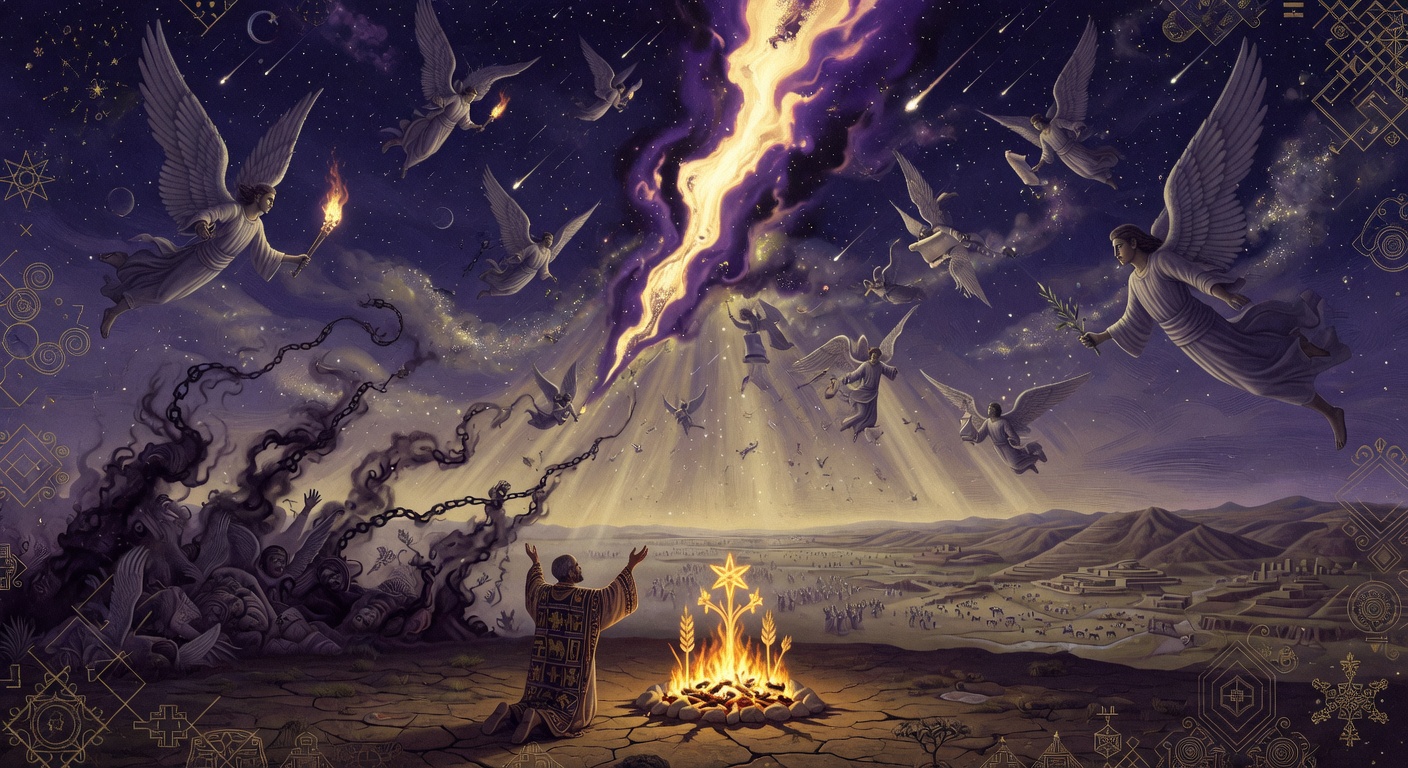
The Covenant with Abraham is the pivotal moment when God binds himself by oath to give land, descendants, and blessing to one man's lineage - the promise that shapes all subsequent patriarchal history. In the rich narratives of Second Temple Jewish literature, the divine assurances extended to Abraham represent a decisive renewal of the cosmic order first articulated after the flood, positioning the patriarch as a central figure in the restoration of righteousness amid a world still shadowed by ancient rebellions. These texts portray the promises of numerous descendants, possession of the land, and blessings extending to all nations not merely as personal favors but as elements inscribed within the heavenly tablets that govern history itself, linking Abraham's fidelity to the broader arc of divine election and judgment. The Book of Jubilees provides the most detailed elaboration, particularly in chapters 14 and 15, where the covenant is formalized through the command of circumcision as an eternal sign, with the promises reiterated during Abraham's vision of the land and his intercession for Sodom's inhabitants. This account stresses the covenant's unbreakable nature, recorded on heavenly tablets, and ties it explicitly to the calendar and festivals observed by the angels. The Book of Jasher complements this by narrating the surrounding trials, including Abraham's departure from Ur and his encounters that test and affirm these commitments, thereby illustrating the patriarch's active role in upholding the divine word across generations. Within the Enochian tradition, which emphasizes the preordination of events as disclosed to the antediluvian scribe, Abraham's covenant functions as a vital bridge between the era of the watchers and the emergence of Israel. Jubilees frequently invokes Enoch's revelations to contextualize these promises, showing how they counteract the lingering effects of primordial transgression and ensure the preservation of a righteous lineage destined to inherit the earth. This framework invites readers to see the covenant as both a historical pivot and an eschatological signpost, underscoring themes of obedience, renewal, and universal blessing that resonate throughout the apocryphal corpus.
Did You Know?
The covenant is renewed multiple times with Abraham, Isaac, and Jacob.
Circumcision is added as the sign in the second renewal.
The covenant ceremony uses split animals - an ancient Near Eastern form of self-curse if the oath is broken.
Only God passes between the pieces - Abraham is asleep, making it a unilateral divine commitment.
The promise includes four hundred years of slavery before deliverance - foreknowledge of suffering.
Key Passage
Covenant with Abraham
The Book of Jubilees 15:1-10
And in the fifth year of the fourth week of this jubilee, 1979 A.M. in the third month, in the middle of the month, Abra...
 1nd in the fifth year of the fourth week of this jubilee, 1979 A.M. in the third month, in the middle of the month, Abram celebrated the feast of the first-fruits of the grain harvest.
Did You Know?
The covenant is renewed multiple times with Abraham, Isaac, and Jacob.
Circumcision is added as the sign in the second renewal.
The covenant ceremony uses split animals - an ancient Near Eastern form of self-curse if the oath is broken.
Only God passes between the pieces - Abraham is asleep, making it a unilateral divine commitment.
The promise includes four hundred years of slavery before deliverance - foreknowledge of suffering.