The Great Flood
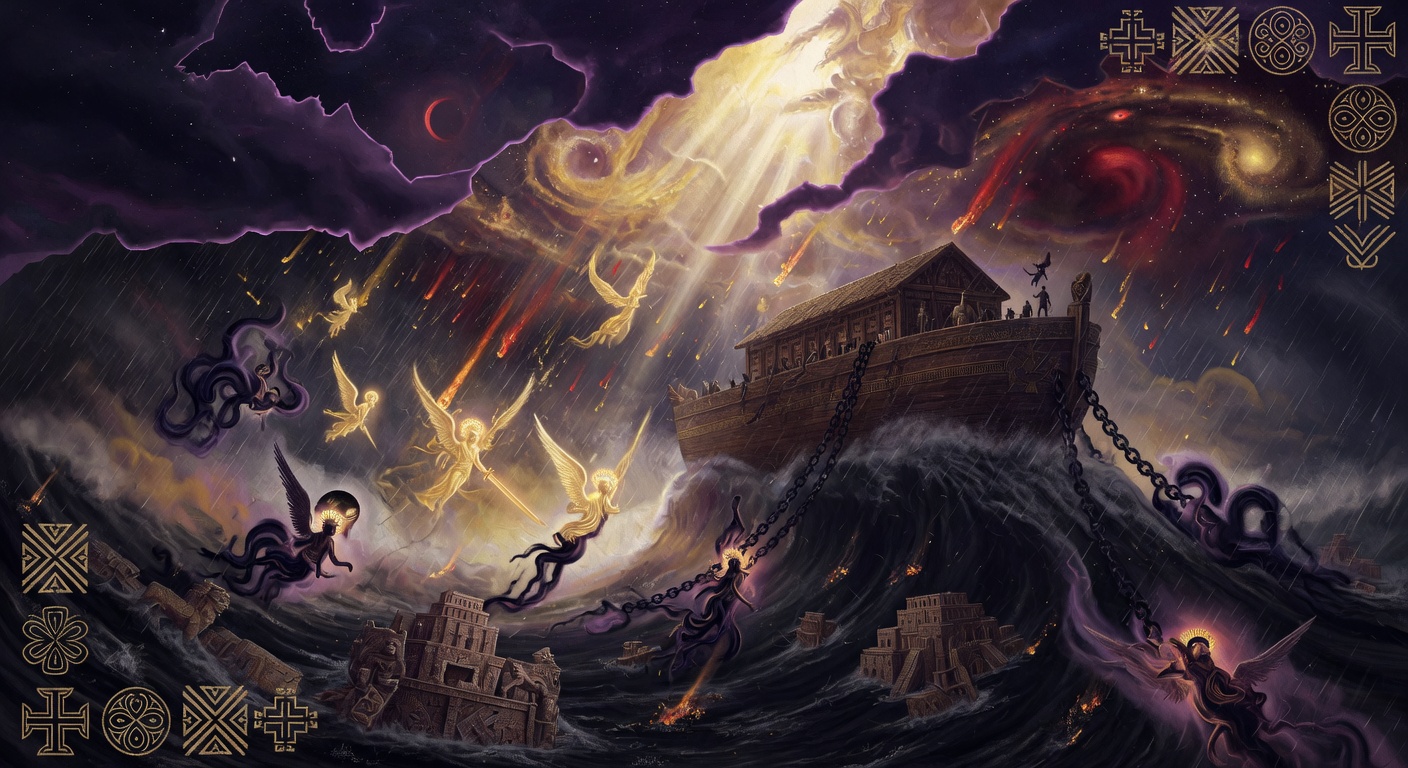
The Flood is the divine judgment that destroyed all life on earth except Noah and those preserved in the Ark - the necessary purge of corruption introduced by the Watchers and their giant offspring. In the Enochian tradition, the cataclysmic deluge emerges as the inevitable consequence of profound cosmic disorder, where the boundaries between the heavenly and earthly realms were violently breached. The Book of Enoch describes how a cadre of angels, led by Semjaza and Azazel, descended upon Mount Hermon and took human wives, imparting forbidden knowledge of metallurgy, cosmetics, and warfare that fueled rampant violence and moral decay across the earth. This transgression produced the monstrous Nephilim, whose insatiable appetites ravaged both humanity and the natural order, prompting the archangels to petition the Most High for judgment as recounted in chapters 6 through 11. The Book of Jubilees elaborates on this narrative by framing the flood within a structured chronology of jubilees, emphasizing that the Watchers’ defilement of sacred laws accelerated the earth’s pollution through bloodshed and idolatry. Noah stands apart as the sole righteous figure who receives divine instruction to construct an ark, preserving not only his family but also the seeds of future life, a detail harmonized across Jubilees 5 and the visionary warnings in 1 Enoch 65-67. These texts portray the event less as arbitrary punishment and more as a necessary purification, restoring balance after the angelic rebellion had threatened the created order itself. The Book of Jasher supplies further narrative texture, depicting the pre-flood generations’ escalating wickedness and Noah’s repeated, unheeded calls for repentance over the course of many decades. Within this broader corpus, the deluge functions as a pivotal turning point that severs the antediluvian age from the renewed covenant established afterward, underscoring themes of divine justice tempered by mercy toward the faithful remnant. Readers encounter here a worldview in which human and angelic actions carry cosmic weight, with the flood serving as both historical rupture and enduring moral exemplar for subsequent generations.
Did You Know?
Jubilees gives precise jubilee dates for the entire event.
Noah's ark lands on Ararat in the 5th month.
The waters prevail for 150 days before beginning to recede - a precise half-year in the solar calendar.
Only eight humans survive - the minimum needed to restart humanity while preserving genetic diversity.
The flood destroys not just humans but the Nephilim, cleansing both natural and unnatural corruption.
Key Passage
The Great Flood
The Book of Enoch 10:1-3
Then said the Most High, the Holy and Great One spake, and sent Uriel to the son of Lamech, and said to him:...
 1hen said the Most High, the Holy and Great One spake, and sent Uriel to the son of Lamech, and said to him:
Did You Know?
Jubilees gives precise jubilee dates for the entire event.
Noah's ark lands on Ararat in the 5th month.
The waters prevail for 150 days before beginning to recede - a precise half-year in the solar calendar.
Only eight humans survive - the minimum needed to restart humanity while preserving genetic diversity.
The flood destroys not just humans but the Nephilim, cleansing both natural and unnatural corruption.