Binding of Isaac (Akedah)
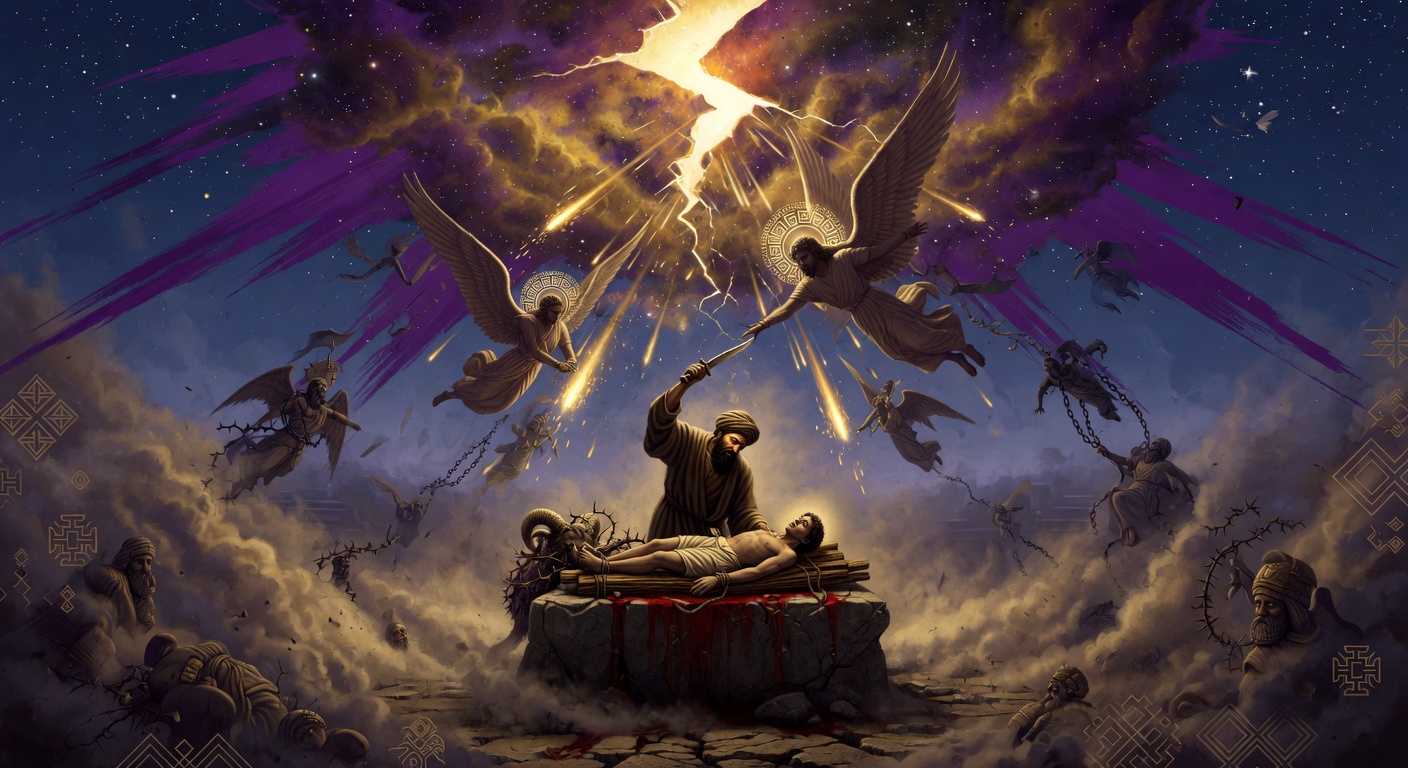
The Sacrifice of Isaac (the Binding) is the supreme test of Abraham's faith - prompted by Mastema in Jubilees - where obedience to the point of offering his son is rewarded by divine provision of a substitute. In the ancient interpretive traditions surrounding the Hebrew patriarchs, the account of Abraham's near-sacrifice of his son emerges as a pivotal moment of divine testing and angelic mediation, elaborated most fully in the Book of Jubilees. This text frames the event not merely as a personal ordeal but as part of a cosmic contest involving Mastema, the adversarial prince who seeks to undermine the covenantal line. Jubilees 17:15-18:19 recounts how Mastema proposes the trial to God, prompting the command for Abraham to offer Isaac on Mount Moriah; throughout the journey, the narrative emphasizes Abraham's unwavering obedience while angels of the presence intervene at the critical moment to halt the blade and affirm the substitutionary ram. Such details underscore the text's concern with calendrical precision and covenantal renewal, situating the episode in the month of Nisan and linking it to future festivals of deliverance. The Book of Jasher expands these motifs with additional narrative texture, portraying the journey to the mountain as fraught with supernatural opposition. In Jasher 22:1-23:15, Satan appears repeatedly in disguise to dissuade both father and son, attempting to exploit human doubts about the promise of descendants; these encounters highlight themes of spiritual warfare that resonate with the Enochic literature's depictions of fallen angels and their influence over human affairs. Although 1 Enoch itself does not narrate the Akedah directly, its Animal Apocalypse in chapters 89-90 symbolically encodes Abraham's lineage within a broader vision of Israel's history, where divine watchers guide and protect the chosen flock amid trials, providing a theological backdrop for understanding angelic roles in later retellings like Jubilees. These expansions within the Enochian and related apocryphal corpus elevate the story beyond its biblical outline, presenting it as a paradigm of faithful resistance to adversarial forces and a foreshadowing of redemptive substitution. Readers encounter an emphasis on the transmission of covenantal promises through generations, with Isaac's survival ensuring the continuity of the line that will ultimately confront the Watchers' legacy of corruption. Such interpretations invite contemplation of how divine sovereignty operates through human agency and heavenly intercession, themes that permeate the pseudepigraphal texts and reward careful cross-referencing across the corpus.
Did You Know?
It is the supreme test of Abraham's faith in both Jubilees and Jasher.
Isaac's willingness is emphasized as much as Abraham's obedience.
Jubilees names Mastema as the instigator who challenges God to test Abraham - a parallel to Job.
The three-day journey to Moriah allows Abraham time to reconsider - the test requires sustained resolve.
The ram provided as substitute establishes the principle of divine provision that runs through all later sacrifice.
Key Passage
Binding of Isaac (Akedah)
The Book of Jubilees 18:1-19
And God said to him, 'Abraham, Abraham'; and he said, Behold, (here) am I.'...
 1nd God said to him, 'Abraham, Abraham'; and he said, Behold, (here) am I.'
Did You Know?
It is the supreme test of Abraham's faith in both Jubilees and Jasher.
Isaac's willingness is emphasized as much as Abraham's obedience.
Jubilees names Mastema as the instigator who challenges God to test Abraham - a parallel to Job.
The three-day journey to Moriah allows Abraham time to reconsider - the test requires sustained resolve.
The ram provided as substitute establishes the principle of divine provision that runs through all later sacrifice.