Jacob's Ladder Dream at Bethel
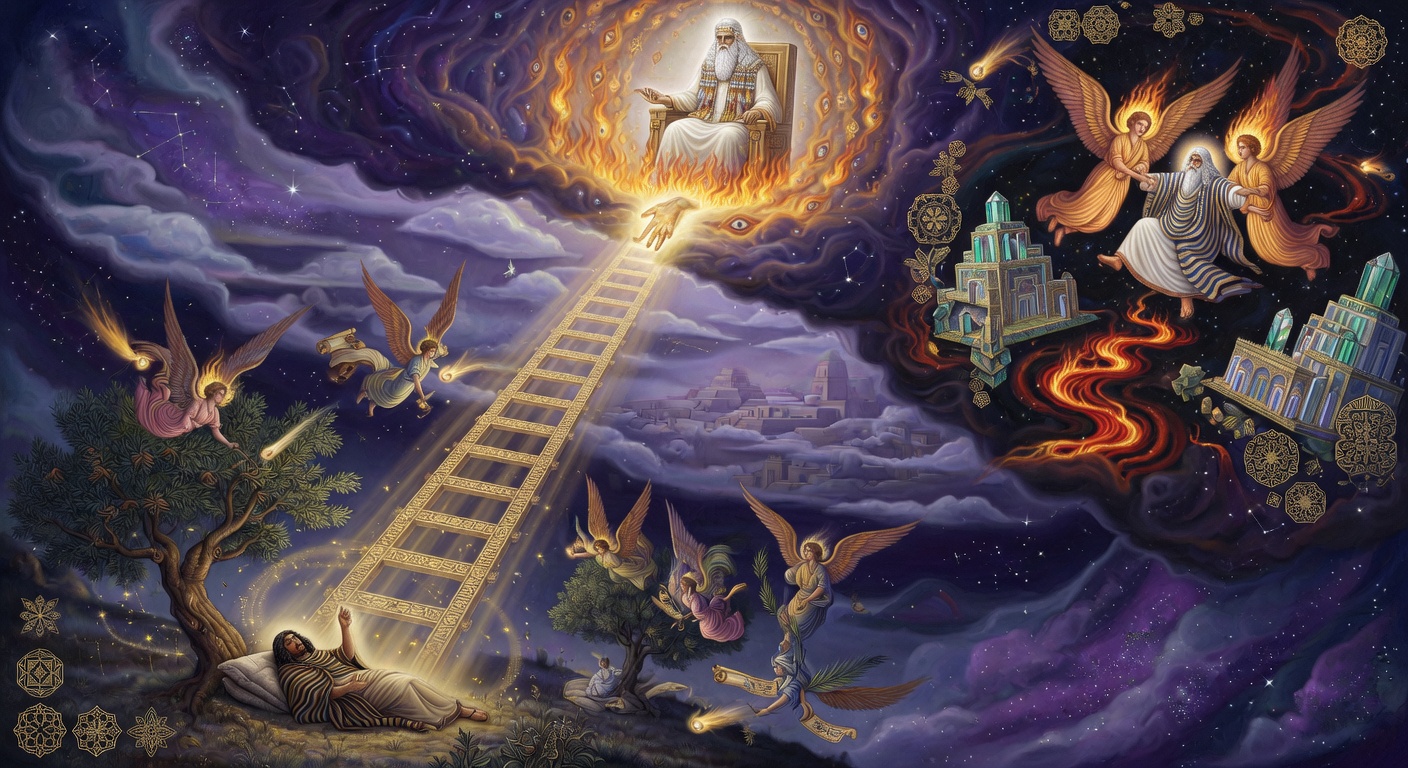
Jacob's Ladder is the vision at Bethel in which the patriarch sees a stairway reaching from earth to heaven with angels ascending and descending - a revelation of the connection between divine and human realms. In the ancient narratives of the patriarchs, moments of divine encounter often bridge the earthly and celestial realms, revealing promises that echo through generations. Jacob's vision at Bethel stands as one such pivotal revelation, where a solitary figure receives personal confirmation of a covenant first granted to his forebears. This episode, elaborated in texts like the Book of Jubilees, underscores themes of angelic mediation and the renewal of sacred bonds amid human wanderings and trials. The Book of Jubilees recounts the dream in chapter 27, depicting Jacob resting at the site he would name Bethel, or the House of God. There he beholds a ladder stretching from earth to heaven, with angels moving along its length, while the Lord stands above and affirms the land's inheritance, numerous descendants, and protective presence. This retelling expands the Genesis account by emphasizing Jacob's subsequent vow and the site's enduring sanctity, framing the vision as a direct transmission of Abrahamic promises tailored to his lineage. The Book of Jasher similarly preserves details of this nocturnal experience, highlighting the dream's role in guiding Jacob's path through familial conflicts and exile. Within the broader Enochian tradition, such ascents and descents resonate with Enoch's own heavenly journeys detailed in 1 Enoch, particularly chapters 14 and 17-36, where portals to divine realms open and watchers traverse between worlds. Jacob's ladder thus mirrors these motifs of structured heavenly access, suggesting a shared cosmology where angels facilitate covenantal continuity and divine oversight. This connection enriches the vision's significance, portraying Bethel not merely as a personal milestone but as an echo of primordial revelations granted to earlier seers like Enoch. The episode ultimately affirms the covenant's vitality across generations, transforming a moment of vulnerability into assurance of blessing and return. By integrating angelic activity with explicit promises of land and progeny, these texts invite readers to see the dream as a foundational link in the chain of sacred history preserved in apocryphal literature.
Details
- Category
- Patriarchal
- Prayed by
- Jacob
Key Chapters
Key Passages
The Dream
The Book of Jubilees 27:19-27
And Jacob went from the Well of the Oath to go to Haran on the first year of the second week in the forty-fourth jubilee...
 19nd Jacob went from the Well of the Oath to go to Haran on the first year of the second week in the forty-fourth jubilee, and he came to Luz on the mountains, that is, Bethel, on the new moon of the first month of this week, 2115 A.M. and he came to the place at even and turned from the way to the west of the road that night: and he slept there; for the sun had set.
In Jasher Detail
The Book of Jasher 30:1-10
And Jacob went forth continuing his road to Haran, and he came as far as mount Moriah, and he tarried there all night ne...
1nd Jacob went forth continuing his road to Haran, and he came as far as mount Moriah, and he tarried there all night near the city of Luz; and the Lord appeared there unto Jacob on that night, and he said unto him, I am the Lord God of Abraham and the God of Isaac thy father; the land upon which thou liest I will give unto thee and thy seed.
Did You Know?
The ladder symbolizes the connection between heaven and earth through the covenant line.
God personally confirms the promises to Jacob here.
The ladder/stairway suggests structured access between heaven and earth - not random or chaotic.
God stands above it speaking promises, while angels perform the actual transit - hierarchy in action.
The stone becomes a pillar anointed with oil - ordinary material consecrated by visionary encounter.