
Feast of Tabernacles (Sukkot)
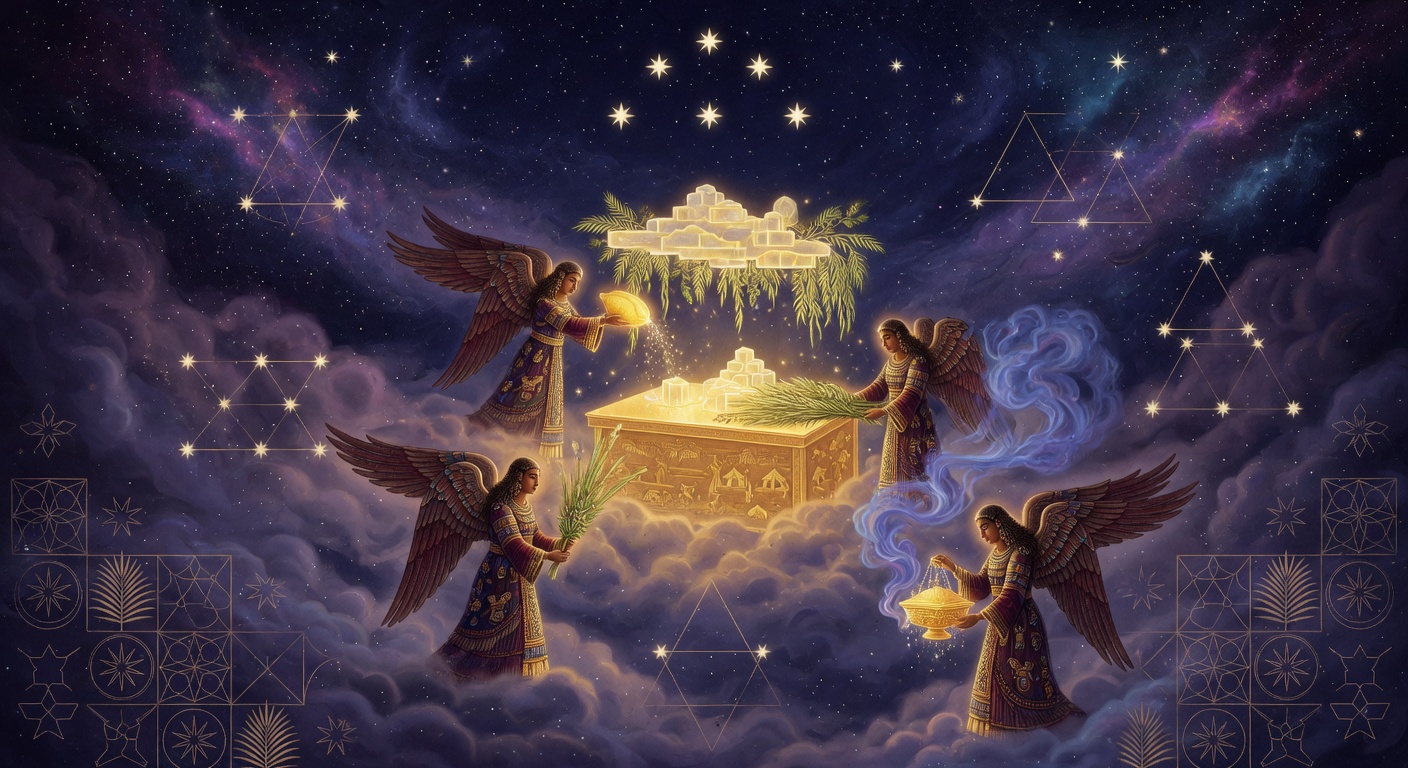
Illustration of Feast of Tabernacles (Sukkot)

The Feast of Tabernacles (Sukkot) is the eight-day autumn festival of dwelling in temporary booths - first observed by Abraham in Canaan according to Jubilees, with roots in heavenly worship. Among the patriarchal narratives preserved in ancient Jewish literature, this eight-day observance stands out for its deep roots in the lives of the forefathers, long before the revelation at Sinai. The Book of Jubilees recounts how Abraham first built booths and kept the festival with joy in the land of Canaan, offering sacrifices each day and dwelling in temporary shelters as a sign of gratitude for the harvest and divine protection. This account in Jubilees 16 portrays the feast not as a later Mosaic institution but as an eternal decree written on heavenly tablets, observed by angels in heaven and commanded for all generations of Israel. The text stresses the festival’s connection to the cycles of creation and the proper reckoning of time. By aligning its dates with the 364-day solar calendar revealed to Enoch, Jubilees integrates the feast into a cosmic order free from lunar drift, ensuring its fixed place each year. Abraham’s celebration includes specific rituals such as processions around the altar and prayers for renewal, elements that underscore the feast’s dual focus on historical remembrance and ongoing agricultural blessing. Within the Enochian and Jubilees tradition, the observance also carries eschatological weight. It serves as a foretaste of the restoration when all nations will ascend to Jerusalem to keep the feast, echoing the heavenly pattern Enoch glimpsed during his tours of the cosmos. The Book of Jasher supplements this picture by noting how later patriarchs renewed similar communal gatherings, reinforcing the continuity of sacred time across generations. Such descriptions invite readers to see the festival as more than historical recall; it embodies an unbroken covenantal rhythm that links earthly worship with angelic service and the enduring promise of divine presence.

0:00

Details

Category
Fall
Timing
15-21 Tishri
Season
Fall

Key Chapters

Key Passages

Tabernacles Regulations

The Book of Jubilees 16:20-31

And he built there an altar to the Lord who had delivered him, and who was making him rejoice in the land of his sojourn...
A20nd he built there an altar to the Lord who had delivered him, and who was making him rejoice in the land of his sojourning, and he celebrated a festival of joy in this month seven days, near the altar which he had built at the Well of the Oath.

21 And he built booths for himself and for his servants on this festival, and he was the first to celebrate the feast of tabernacles on the earth. 22 And during these seven days he brought each day to the altar a burnt offering to the Lord, two oxen, two rams, seven sheep, one he-goat, for a sin offering, that he might atone thereby for himself and for his seed. 23 And, as a thank-offering, seven rams, seven kids, seven sheep, and seven he-goats, and their fruit offerings and their drink offerings; and he burnt all the fat thereof on the altar, a chosen offering unto the Lord for a sweet smelling savour. 24 And morning and evening he burnt fragrant substances, frankincense and galbanum, and stackte, and nard, and myrrh, and spice, and costum; all these seven he offered, crushed, mixed together in equal parts (and) pure. 25 And he celebrated this feast during seven days, rejoicing with all his heart and with all his soul, he and all those who were in his house, and there was no stranger with him, nor any that was uncircumcised. 26 And he blessed his Creator who had created him in his generation, for He had created him according to His good pleasure; for He knew and perceived that from him would arise the plant of righteousness for the eternal generations, and from him a holy seed, so that it should become like Him who had made all things. 27 And he blessed and rejoiced, and he called the name of this festival the festival of the Lord, a joy acceptable to the Most High God. 28 And we blessed him for ever, and all his seed after him throughout all the generations of the earth, because he celebrated this festival in its season, according to the testimony of the heavenly tablets. 29 For this reason it is ordained on the heavenly tablets concerning Israel, that they shall celebrate the feast of tabernacles seven days with joy, in the seventh month, acceptable before the Lord -a statute for ever throughout their generations every year. 30 And to this there is no limit of days; for it is ordained for ever regarding Israel that they should celebrate it and dwell in booths, and set wreaths upon their heads, and take leafy boughs, and willows from the brook. 31 And Abraham took branches of palm trees, and the fruit of goodly trees, and every day going round the altar with the branches seven times a day in the morning, he praised and gave thanks to his God for all things in joy.

Abraham Observes It

The Book of Jubilees 16:20-31

And he built there an altar to the Lord who had delivered him, and who was making him rejoice in the land of his sojourn...

A20nd he built there an altar to the Lord who had delivered him, and who was making him rejoice in the land of his sojourning, and he celebrated a festival of joy in this month seven days, near the altar which he had built at the Well of the Oath.

21 And he built booths for himself and for his servants on this festival, and he was the first to celebrate the feast of tabernacles on the earth. 22 And during these seven days he brought each day to the altar a burnt offering to the Lord, two oxen, two rams, seven sheep, one he-goat, for a sin offering, that he might atone thereby for himself and for his seed. 23 And, as a thank-offering, seven rams, seven kids, seven sheep, and seven he-goats, and their fruit offerings and their drink offerings; and he burnt all the fat thereof on the altar, a chosen offering unto the Lord for a sweet smelling savour. 24 And morning and evening he burnt fragrant substances, frankincense and galbanum, and stackte, and nard, and myrrh, and spice, and costum; all these seven he offered, crushed, mixed together in equal parts (and) pure. 25 And he celebrated this feast during seven days, rejoicing with all his heart and with all his soul, he and all those who were in his house, and there was no stranger with him, nor any that was uncircumcised. 26 And he blessed his Creator who had created him in his generation, for He had created him according to His good pleasure; for He knew and perceived that from him would arise the plant of righteousness for the eternal generations, and from him a holy seed, so that it should become like Him who had made all things. 27 And he blessed and rejoiced, and he called the name of this festival the festival of the Lord, a joy acceptable to the Most High God. 28 And we blessed him for ever, and all his seed after him throughout all the generations of the earth, because he celebrated this festival in its season, according to the testimony of the heavenly tablets. 29 For this reason it is ordained on the heavenly tablets concerning Israel, that they shall celebrate the feast of tabernacles seven days with joy, in the seventh month, acceptable before the Lord -a statute for ever throughout their generations every year. 30 And to this there is no limit of days; for it is ordained for ever regarding Israel that they should celebrate it and dwell in booths, and set wreaths upon their heads, and take leafy boughs, and willows from the brook. 31 And Abraham took branches of palm trees, and the fruit of goodly trees, and every day going round the altar with the branches seven times a day in the morning, he praised and gave thanks to his God for all things in joy.

Isaac born during Tabernacles

The Book of Jubilees 16:12-19

And in the middle of the sixth month the Lord visited Sarah and did unto her as He had spoken and she conceived....

A12nd in the middle of the sixth month the Lord visited Sarah and did unto her as He had spoken and she conceived.

13 And she bare a son in the third month, and in the middle of the month, at the time of which the Lord had spoken to Abraham, on the festival of the first fruits of the harvest, Isaac was born. 14 And Abraham circumcised his son on the eighth day: he was the first that was circumcised according to the covenant which is ordained for ever. 15 And in the sixth year of the fourth week we came to Abraham, to the Well of the Oath, and we appeared unto him as we had told Sarah that we should return to her, and she would have conceived a son. 16 And we returned in the seventh month, and found Sarah with child before us and we blessed him, and we announced to him all the things which had been decreed concerning him, that he should not die till he should beget six sons more, and should see (them) before he died; but (that) in Isaac should his name and seed be called: 17 And (that) all the seed of his sons should be Gentiles, and be reckoned with the Gentiles; but from the sons of Isaac one should become a holy seed, and should not be reckoned among the Gentiles. 18 For he should become the portion of the Most High, and all his seed had fallen into the possession of God, that it should be unto the Lord a people for (His) possession above all nations and that it should become a kingdom and priests and a holy nation. 19 And we went our way, and we announced to Sarah all that we had told him, and they both rejoiced with exceeding great joy.

Did You Know?

1

Abraham is the first human to observe it in Jubilees.

2

It includes living in booths and specific sacrifices for eight days.

3

Abraham is credited as the first human to build booths and celebrate this feast in Canaan.

4

The eight-day duration includes specific sacrifices that decrease in number each day.

5

Living in temporary shelters recalls both wilderness dependence and eschatological hope.