Tabernacle / Tent of Meeting
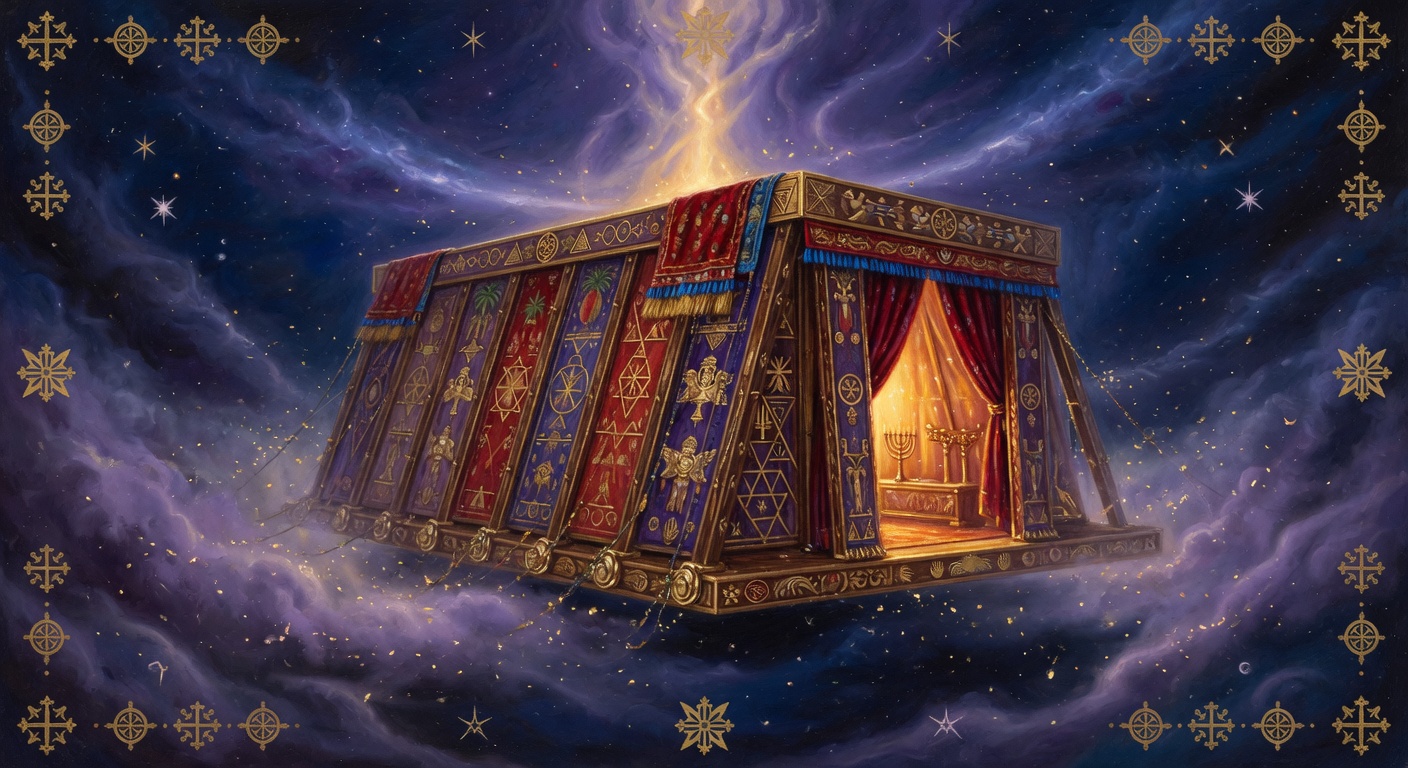
The Tabernacle is the portable sanctuary built to divine specifications, serving as the earthly dwelling of God's presence among Israel during the wilderness wanderings - patterned after heavenly realities Enoch witnessed. In the pseudepigraphal traditions that expand upon the biblical narrative of revelation at Sinai, the portable sanctuary emerges as a divinely ordained structure whose design originates in heavenly patterns rather than human invention. The Book of Jubilees presents this dwelling as central to the renewal of the covenant, with God instructing Moses on Mount Sinai to record its specifications so that Israel might construct it precisely according to the model shown in the heavenly realm. This emphasis underscores the sanctuary not merely as a temporary tent but as the earthly counterpart to an eternal order, ensuring that divine presence remains accessible amid the people’s journey through the wilderness and beyond. Jubilees further highlights the meticulous attention given to the sanctuary’s construction and its perpetual service, portraying the Tabernacle as a safeguard against the defilement that had previously corrupted the earth. Specific passages, such as Jubilees 1:27 and the surrounding instructions in the opening chapter, stress that the structure must be erected according to exact heavenly measurements, with its rituals and furnishings serving as an unbroken link to the primordial order established at creation. The text insists on the sanctuary’s enduring role across generations, framing its service as an eternal ordinance that transcends the immediate Exodus events and anticipates future restoration. Within the broader Enochian corpus, visions of heavenly temples and thrones, as seen in 1 Enoch 14, provide the archetypal backdrop for understanding the earthly Tabernacle. Enoch’s ascent reveals a celestial house of crystal and fire whose architecture prefigures the Tabernacle’s layout, suggesting that Moses received not an original design but a copy of preexisting divine realities. This connection reinforces the idea that the sanctuary functions as a bridge between the fallen world and the unchanging heavenly realm. References in the Book of Jasher supplement these accounts by detailing the practical assembly of the structure from materials gathered in the wilderness, illustrating how the community’s obedience to the revealed pattern enabled the divine presence to dwell among them. Together these texts present the Tabernacle as both a historical necessity and a theological symbol of covenant fidelity.
Details
- Category
- Sanctuary
- Associated With
- Moses, Aaron
- Locations
- The Wilderness
Key Chapters
Key Passages
Pattern and Construction
The Book of Jubilees 1:27-29
And the Lord will appear to the eyes of all, and all shall know that I am the God of Israel and the Father of all the ch...
 27nd the Lord will appear to the eyes of all, and all shall know that I am the God of Israel and the Father of all the children of Jacob, and King on Mount Zion for all eternity. And Zion and Jerusalem shall be holy.'
Tabernacle laws in Jubilees
The Book of Jubilees 49:18-21
And when the children of Israel come into the land which they are to possess, into the land of Canaan, and set up the ta...
18nd when the children of Israel come into the land which they are to possess, into the land of Canaan, and set up the tabernacle of the Lord in the midst of the land in one of their tribes until the sanctuary of the Lord has been built in the land, let them come and celebrate the passover in the midst of the tabernacle of the Lord, and let them slay it before the Lord from year to year.
Did You Know?
Its pattern was shown to Moses on the mountain.
Jubilees presents it as the earthly counterpart to the heavenly sanctuary.
Jubilees positions the tabernacle as one of the four holiest sites on earth, alongside Eden, Sinai, and Zion.
The portable design allowed God's presence to travel with Israel through the wilderness, a mobile heaven-on-earth.
Every material and measurement mirrors heavenly realities that Enoch witnessed in his celestial journeys.