Faith and Righteousness of the Patriarchs
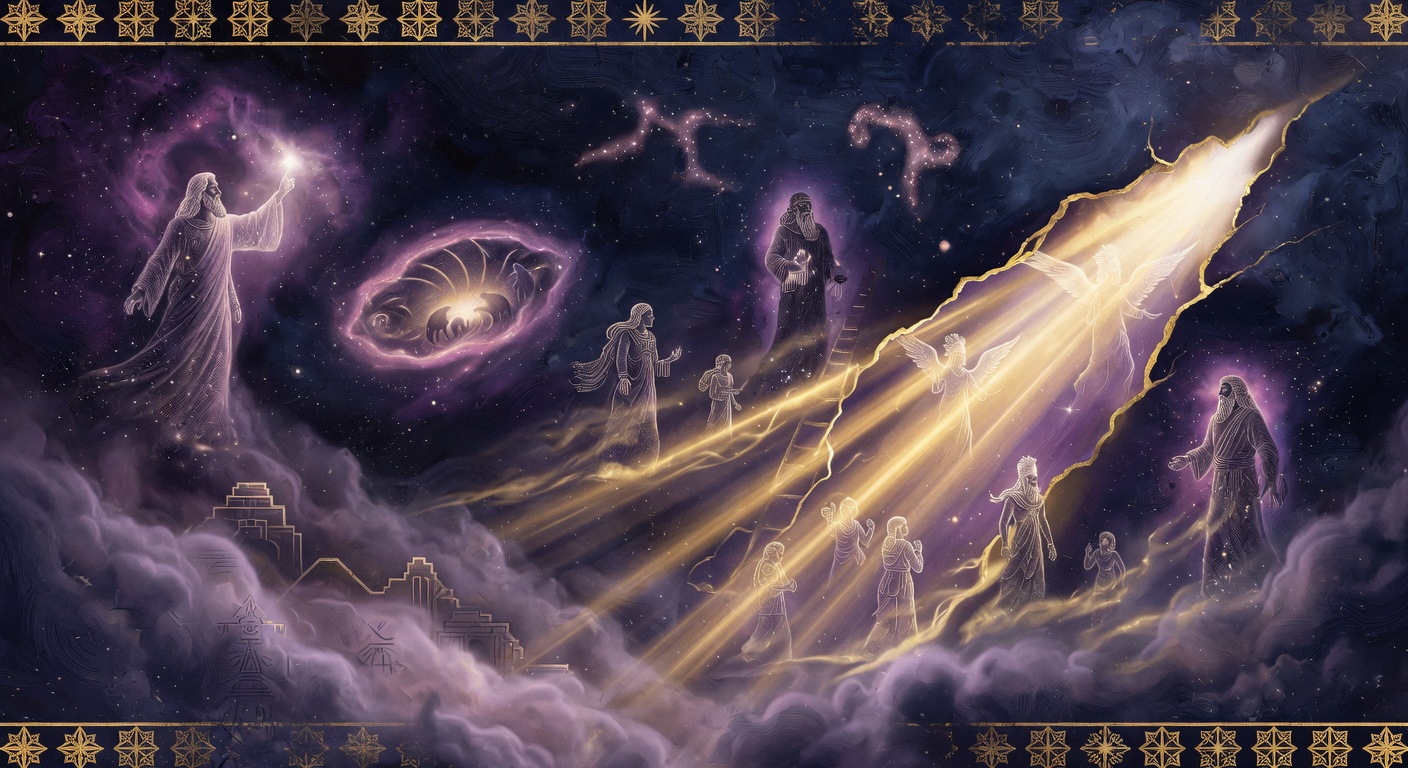
Faith in these ancient texts represents the steadfast trust in divine promises and cosmic justice that sustains the righteous through persecution, exile, and the apparent triumph of evil. In the ancient Jewish traditions preserved through pseudepigraphal works, the early patriarchs emerge as enduring exemplars of fidelity to divine commands amid a world increasingly estranged from its creator. These texts expand upon terse biblical notices to portray individuals whose inner conviction and outward conduct sustain the covenant across generations marked by angelic transgression and human corruption. Within the Enochic corpus, such figures anchor the hope that a righteous line will persist until the final judgment restores cosmic order. Enoch himself embodies this ideal through his intimate communion with heavenly mysteries. The Book of Enoch describes his translation to the divine presence without experiencing death, while Jubilees 4:17-25 credits him with recording astronomical and calendrical knowledge that safeguards sacred time. Noah, in turn, receives explicit commendation in Jubilees 5-6 for obeying precise instructions that preserve life through the deluge, thereby renewing the created order under renewed covenant stipulations. Abraham and Jacob further illustrate progressive testing and endurance. Jubilees 18 recounts Abraham’s unhesitating response to the command concerning Isaac, an act framed as the supreme demonstration of loyalty that secures blessings for his descendants. The Book of Jasher elaborates Jacob’s nocturnal struggle and subsequent perseverance through familial trials, presenting these as the means by which the patriarchal promise advances despite opposition. Together these accounts supply concrete models for the faithful remnant envisioned in Enochic eschatology, showing how individual righteousness maintains the thread of divine purpose until the age of restoration.
Details
- Category
- Patriarchal Example
- Key Figures
- Enoch, Noah, Abraham, Jacob (Israel)
- Passages
- 6 key references
Key Chapters
Key Passages
Enoch Walked with God
The Book of Enoch 1:1-3
The words of the blessing of Enoch, wherewith he blessed the elect and righteous, who will be living in the day of tribu...
 1he words of the blessing of Enoch, wherewith he blessed the elect and righteous, who will be living in the day of tribulation, when all the wicked and godless are to be removed.
Blessing promised to the elect
The Book of Enoch 5:5-9
Therefore shall ye execrate your days, And the years of your life shall perish, And the years of your destruction shall ...
5herefore shall ye execrate your days, And the years of your life shall perish, And the years of your destruction shall be multiplied in eternal execration, And ye shall find no mercy. 6a. In those days ye shall make your names an eternal execration unto all the righteous, 6b. And by you shall all who curse, curse, 6c. And all the sinners and godless shall imprecate by you, 7c. And for you the godless there shall be a curse. 6d. And all the . . .shall rejoice, 6e. And there shall be forgiveness of sins, 6f. And every mercy and peace and forbearance: 6g. There shall be salvation unto them, a goodly light. 6i. And for all of you sinners there shall be no salvation, 6j. But on you all shall abide a curse. 7a. But for the elect there shall be light and joy and peace, 7b. And they shall inherit the earth.
The righteous shine like stars
The Book of Enoch 104:1-6
I swear unto you, that in heaven the angels remember you for good before the glory of the Great One: and your names are ...
 1 swear unto you, that in heaven the angels remember you for good before the glory of the Great One: and your names are written before the glory of the Great One.
Assurance to the righteous
The Book of Enoch 103:1-4
Now, therefore, I swear to you, the righteous, by the glory of the Great and Honoured and Mighty One in dominion, and by...
 1ow, therefore, I swear to you, the righteous, by the glory of the Great and Honoured and Mighty One in dominion, and by His greatness I swear to you.
God and the Messiah dwell with man
The Book of Enoch 105:1-2
In those days the Lord bade (them) to summon and testify to the children of earth concerning their wisdom: Show (it) unt...
1n those days the Lord bade (them) to summon and testify to the children of earth concerning their wisdom: Show (it) unto them; for ye are their guides, and a recompense over the whole earth.
Concluding fragment on reward
The Book of Enoch 108:1-15
Another book which Enoch wrote for his son Methuselah and for those who will come after him, and keep the law in the las...
 1nother book which Enoch wrote for his son Methuselah and for those who will come after him, and keep the law in the last days.
Did You Know?
Enoch, Noah, and Abraham are the great examples of walking with God.
Their righteousness is credited to them before the Law at Sinai.
Noah's faith is proven over 120 years of building while enduring mockery - long-term perseverance.
Abraham's faith is tested through fire (literally in Jasher) before it's tested through sacrifice.
Enoch's faithfulness results in translation - bypassing death entirely as ultimate reward.