๐Ÿ“ข Book audio, podcasts, and more coming soon. Some features are still in development.

Skip to main content

The Burning Bush

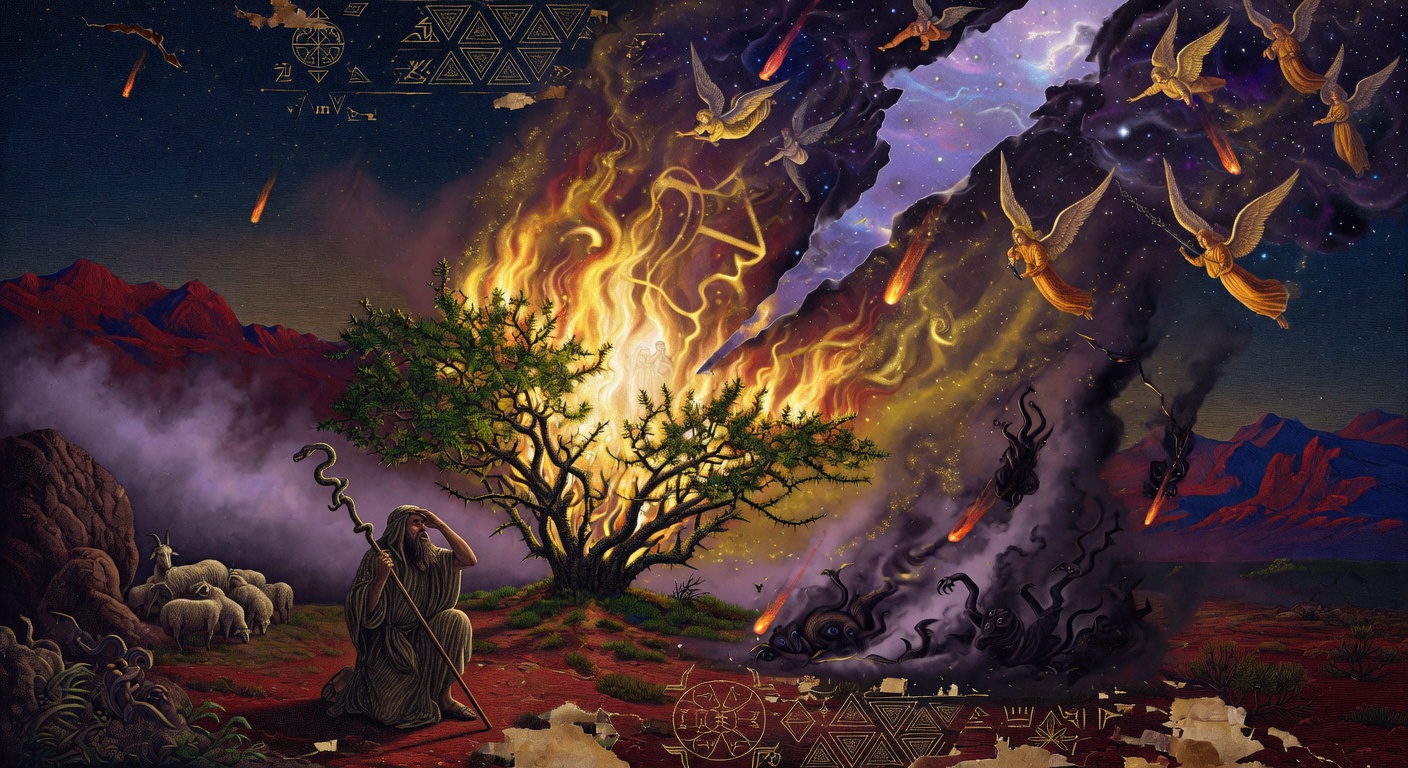
Illustration of The Burning Bush
Era
Exodus
Date
Exodus โ—‹ Traditional
Reference
The Book of Jasher 79:1-20

The Burning Bush is God's direct appearance to Moses in the wilderness of Midian - a fire that burns without consuming, from which the divine voice commissions the reluctant shepherd to return to Egypt and deliver Israel from bondage. Jasher 79 describes the encounter after Moses has spent years tending Reuel's flocks in the wilderness. The bush that burns without being consumed demonstrates that divine presence can inhabit creation without destroying it. Moses receives his commission, his staff becomes a sign, and Aaron is appointed as his spokesman. This theophany bridges the forty years of preparation with the confrontation with Pharaoh that will follow. This event represents a critical juncture in the sacred chronology that the Books of Enoch, Jubilees, and Jasher collectively preserve. Within the jubilee framework that Jubilees meticulously tracks, it occupies a precise position in the divine timetable - not an accident of history but a predetermined turning point inscribed on the heavenly tablets before creation. The expanded narratives in Jasher and the theological interpretations in Jubilees together provide a multidimensional understanding of this moment that illuminates both its immediate consequences and its role in the larger pattern of divine action spanning from creation to final judgment.

0:00

Did You Know?

1

The fire burns without consuming the bush - divine presence inhabits creation without destroying it.

2

Moses is told to remove his sandals because the ground is holy - sacred space exists in wilderness.

3

His staff becomes the instrument of signs throughout the entire Exodus narrative.

4

Aaron is appointed as spokesman because Moses claims difficulty speaking.

5

The divine name is revealed here - connecting identity to the commissioning.

Key Passage

The Burning Bush

The Book of Jasher 79:1-20

And in those days Moses was feeding the flock of Reuel the Midianite his father-in-law, beyond the wilderness of Sin, an...

A1nd in those days Moses was feeding the flock of Reuel the Midianite his father-in-law, beyond the wilderness of Sin, and the stick which he took from his father-in-law was in his hand.

2 And it came to pass one day that a kid of goats strayed from the flock, and Moses pursued it and it came to the mountain of God to Horeb. 3 And when he came to Horeb, the Lord appeared there unto him in the bush, and he found the bush burning with fire, but the fire had no power over the bush to consume it. 4 And Moses was greatly astonished at this sight, wherefore the bush was not consumed, and he approached to see this mighty thing, and the Lord called unto Moses out of the fire and commanded him to go down to Egypt, to Pharaoh king of Egypt, to send the children of Israel from his service. 5 And the Lord said unto Moses, Go, return to Egypt, for all those men who sought thy life are dead, and thou shalt speak unto Pharaoh to send forth the children of Israel from his land. 6 And the Lord showed him to do signs and wonders in Egypt before the eyes of Pharaoh and the eyes of his subjects, in order that they might believe that the Lord had sent him. 7 And Moses hearkened to all that the Lord had commanded him, and he returned to his father-in-law and told him the thing, and Reuel said to him, Go in peace. 8 And Moses rose up to go to Egypt, and he took his wife and sons with him, and he was at an inn in the road, and an angel of God came down, and sought an occasion against him. 9 And he wished to kill him on account of his first born son, because he had not circumcised him, and had transgressed the covenant which the Lord had made with Abraham. 10 For Moses had hearkened to the words of his father-in-law which he had spoken to him, not to circumcise his first born son, therefore he circumcised him not. 11 And Zipporah saw the angel of the Lord seeking an occasion against Moses, and she knew that this thing was owing to his not having circumcised her son Gershom. 12 And Zipporah hastened and took of the sharp rock stones that were there, and she circumcised her son, and delivered her husband and her son from the hand of the angel of the Lord. 13 And Aaron the son of Amram, the brother of Moses, was in Egypt walking at the river side on that day. 14 And the Lord appeared to him in that place, and he said to him, Go now toward Moses in the wilderness, and he went and met him in the mountain of God, and he kissed him. 15 And Aaron lifted up his eyes, and saw Zipporah the wife of Moses and her children, and he said unto Moses, Who are these unto thee? 16 And Moses said unto him, They are my wife and sons, which God gave to me in Midian; and the thing grieved Aaron on account of the woman and her children. 17 And Aaron said to Moses, Send away the woman and her children that they may go to her father's house, and Moses hearkened to the words of Aaron, and did so. 18 And Zipporah returned with her children, and they went to the house of Reuel, and remained there until the time arrived when the Lord had visited his people, and brought them forth from Egypt from the hand at Pharaoh. 19 And Moses and Aaron came to Egypt to the community of the children of Israel, and they spoke to them all the words of the Lord, and the people rejoiced an exceeding great rejoicing. 20 And Moses and Aaron rose up early on the next day, and they went to the house of Pharaoh, and they took in their hands the stick of God.

Read full chapter: The Book of Jasher 79 โ†’

Did You Know?

1

The fire burns without consuming the bush - divine presence inhabits creation without destroying it.

2

Moses is told to remove his sandals because the ground is holy - sacred space exists in wilderness.

3

His staff becomes the instrument of signs throughout the entire Exodus narrative.

4

Aaron is appointed as spokesman because Moses claims difficulty speaking.

5

The divine name is revealed here - connecting identity to the commissioning.