Exodus and Wilderness
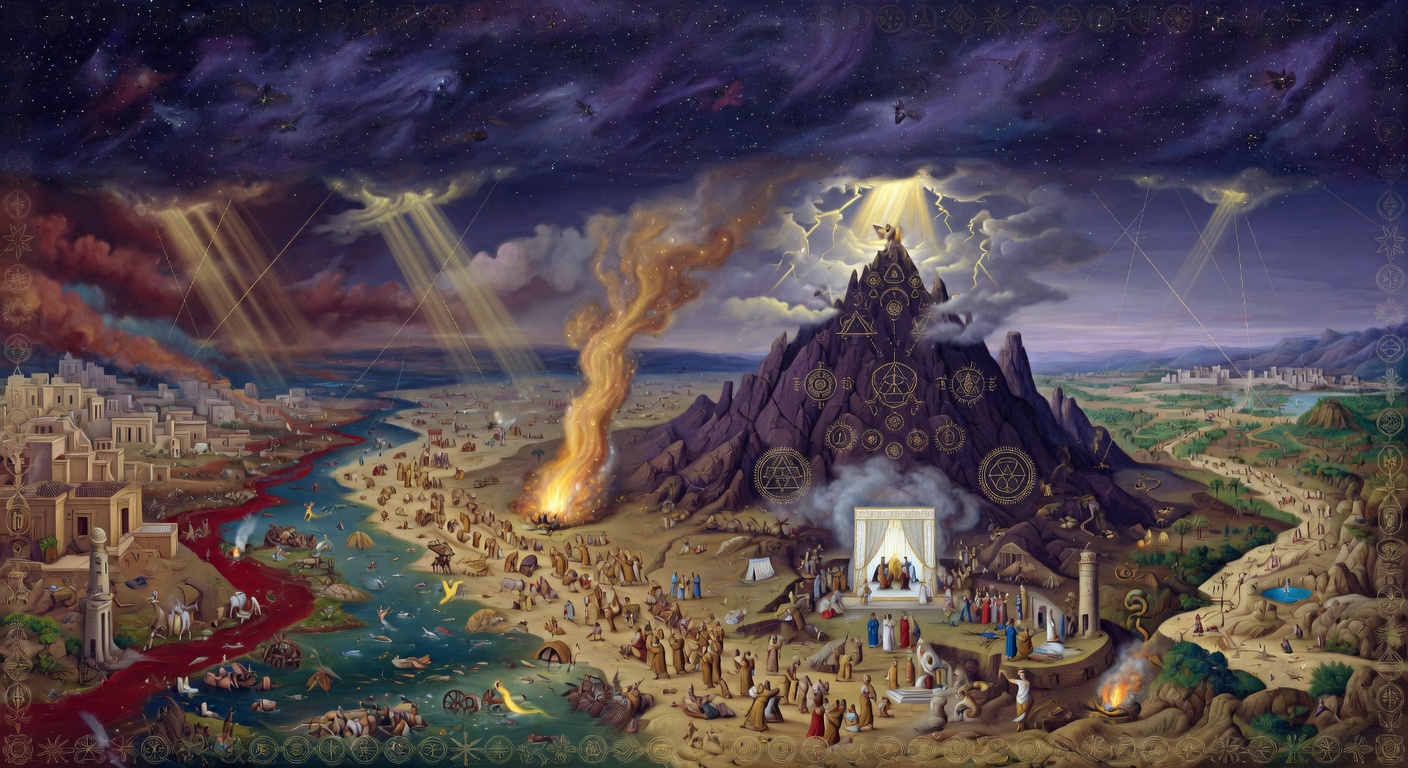
The Exodus Era encompasses Israel's deliverance from Egypt, the giving of the Law at Sinai, and the forty-year wilderness journey - the period when Jubilees' precise calendar and festival system is formally revealed. The pivotal era of liberation and covenant-making unfolds across the ancient pseudepigrapha as a decisive turning point in which heavenly decrees intersect with human history. In the Book of Jubilees, this period receives careful chronological framing within a larger system of jubilees and weeks, where the plagues upon Egypt and the subsequent departure are presented not merely as acts of deliverance but as fulfillments of oaths sworn to the patriarchs. Jubilees 48 recounts the confrontation between Moses and the Egyptian magicians under the watchful direction of the angel of the presence, emphasizing that each plague systematically dismantled the dominion of Mastema and his forces. The text thereby situates these events within an ongoing cosmic struggle that echoes the earlier rebellion of the Watchers described in 1 Enoch. The wilderness narratives receive equally detailed treatment, particularly in the Book of Jasher, which expands upon the journey from the Red Sea to Sinai with accounts of provision, rebellion, and divine instruction. Here the giving of the Law is portrayed as the restoration of an order once known to Enoch and Noah but obscured by subsequent generations. Jasher records extended descriptions of the encampment at Sinai, the construction of the tabernacle according to patterns shown on the mountain, and the repeated cycles of complaint and judgment during the years of wandering. These expansions complement the more concise biblical outline by underscoring the role of angelic mediation and the precise measurement of time that Jubilees likewise stresses in its festival calendar. Within 1 Enoch the same sequence appears in visionary, allegorical form through the Animal Apocalypse. The white bull that becomes a man (representing Moses) leads the flock out of Egypt, receives the Law amid fire on the mountain, and guides the sheep toward a renewed sanctuary. This symbolic retelling links the Exodus era directly to the primordial revelations granted to Enoch, presenting the wilderness legislation as a partial recovery of the heavenly tablets shown to the seventh patriarch. Together these texts invite readers to view the journey toward the promised land as both historical event and typological pattern, wherein obedience to the revealed Law determines whether the community will enter rest or continue under judgment.
Did You Know?
The giving of the Law includes the complete history as revelation.
Jubilees ends with detailed Sabbath and feast regulations.
The giving of the Law includes the complete history as revelation - Moses receives past and future simultaneously.
Jubilees ends with Sabbath and feast regulations, framing the entire Exodus as a calendrical revelation.
The forty years in the wilderness correspond to forty days on the mountain - time scaled between realms.