Fall of Jericho
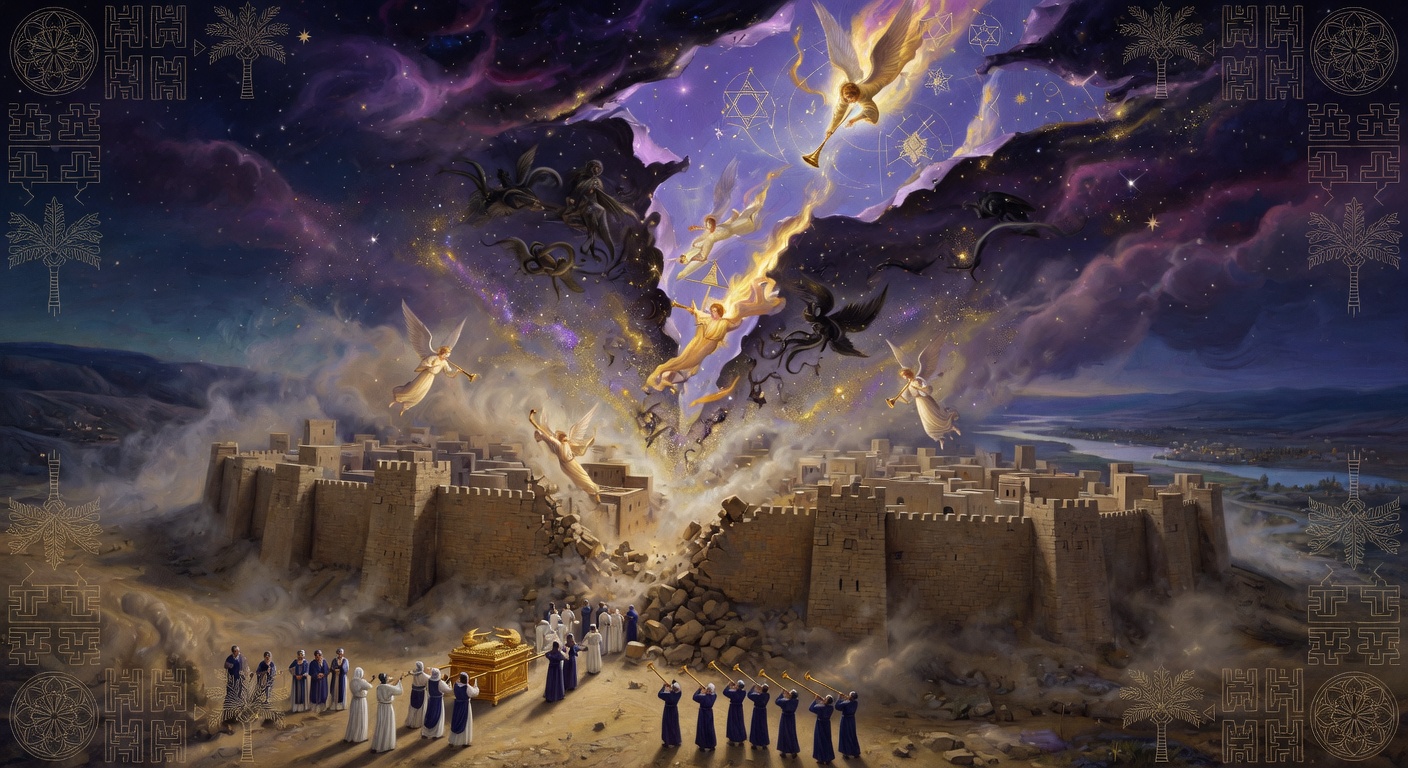
The Fall of Jericho is the first conquest victory in which seven days of ritual procession and trumpet blasts caused the city walls to collapse inward - demonstrating that the promised land would be taken through obedience to divine instruction rather than conventional military force. Jasher 88 describes the prescribed ritual in detail: seven days of silent marching with priests carrying the ark, trumpets sounding each circuit, and on the seventh day a unified shout that brings the walls down. The pattern of sevens connects to the sabbatical and jubilee structures that govern all of Jubilees' chronology. This first city falls not through siege or assault but through liturgical procession - warfare as worship. This event represents a critical juncture in the sacred chronology that the Books of Enoch, Jubilees, and Jasher collectively preserve. Within the jubilee framework that Jubilees meticulously tracks, it occupies a precise position in the divine timetable - not an accident of history but a predetermined turning point inscribed on the heavenly tablets before creation. The expanded narratives in Jasher and the theological interpretations in Jubilees together provide a multidimensional understanding of this moment that illuminates both its immediate consequences and its role in the larger pattern of divine action spanning from creation to final judgment.
Did You Know?
Seven days of silent marching build unbearable psychological pressure on the defenders.
The trumpets are ram's horns (shofars), the same instruments used in worship and jubilee.
The walls collapse inward, not outward - consistent with supernatural rather than siege destruction.
The seven-day pattern connects to creation, sabbath, and jubilee structures throughout Jubilees.
This first city falls through liturgical procession - warfare as worship, not engineering.
Key Passage
Fall of Jericho
The Book of Jasher 88:14-20
And it was in the second month, on the first day of the month, that the Lord said to Joshua, Rise up, behold I have give...
 14nd it was in the second month, on the first day of the month, that the Lord said to Joshua, Rise up, behold I have given Jericho into thy hand with all the people thereof; and all your fighting men shall go round the city, once each day, thus shall you do for six days.
Did You Know?
Seven days of silent marching build unbearable psychological pressure on the defenders.
The trumpets are ram's horns (shofars), the same instruments used in worship and jubilee.
The walls collapse inward, not outward - consistent with supernatural rather than siege destruction.
The seven-day pattern connects to creation, sabbath, and jubilee structures throughout Jubilees.
This first city falls through liturgical procession - warfare as worship, not engineering.