Giving of the Law at Sinai
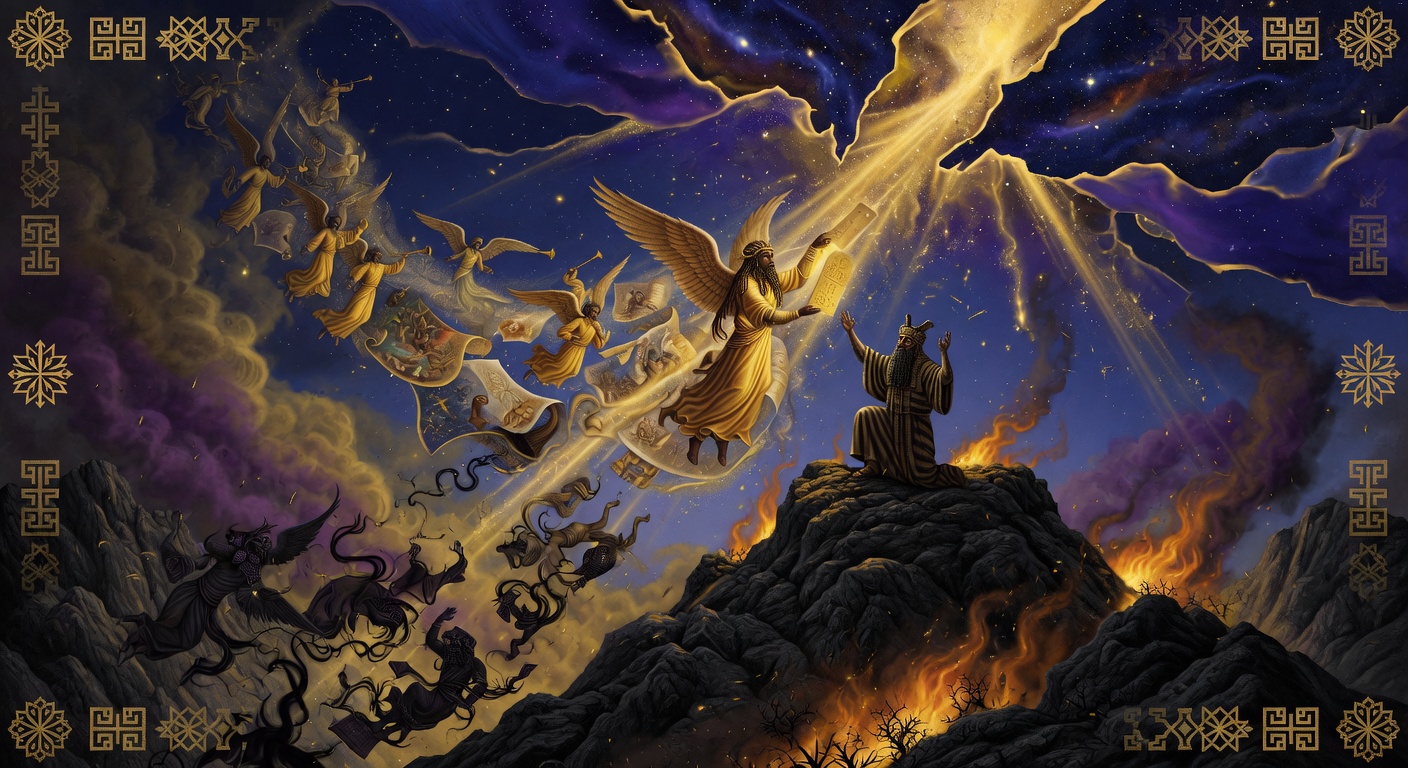
The Giving of the Law at Sinai is the revelation to Moses of the complete divine will - not just commandments but the entire hidden history of the world from creation onward, dictated by the Angel of the Presence. In the landscape of Second Temple Jewish writings, the revelation on Mount Sinai represents a decisive transmission of divine knowledge, where Moses encounters an angelic mediator who unfolds both the commandments and the entire sweep of sacred history. This event bridges the antediluvian revelations granted to Enoch with the covenantal framework established for Israel, underscoring how heavenly secrets are preserved and renewed across generations. Within these traditions, Sinai is not merely a legal moment but a continuation of the same angelic instruction that shaped earlier patriarchs, ensuring that cosmic order and moral law remain intertwined. The Book of Jubilees provides the most detailed account, portraying Moses ascending the mountain for forty days and nights while the Angel of the Presence dictates the narrative from creation onward. In Jubilees 1, the angel instructs Moses to record the words spoken on Sinai, recounting how the law was inscribed on heavenly tablets from the beginning of time and emphasizing its eternal validity, including festivals, sabbaths, and prohibitions against idolatry. This retelling integrates the Exodus events with Genesis material, revealing that the commandments given to Moses were already observed by the patriarchs and rooted in the same divine order Enoch had glimpsed during his heavenly tours. The Book of Jasher expands the human drama surrounding the theophany, describing the thunder, fire, and trembling of the people as Moses receives the tablets, while also noting how prior knowledge from figures like Enoch informed the expectations of the covenant. Enochic literature, though centered on pre-flood visions, supplies the conceptual foundation through its emphasis on angelic scribes and watchers who mediate knowledge of the heavens, a pattern that Jubilees extends directly to Sinai. Together these texts present the giving of the law as the culmination of an ongoing heavenly archive, where angels ensure that truth endures despite human frailty. This framing invites readers to see Sinai as the point where Enoch’s apocalyptic insights become practical legislation for a chosen people, preserving the unity of history, calendar, and ethics across the pseudepigraphic corpus.
Did You Know?
Moses receives not only the Law but the entire history from creation.
The calendar and feasts are presented as already ancient.
Moses receives not just commandments but the entire hidden history of the world from creation onward.
The angel of the presence serves as dictation source - even Moses cannot hear God's voice directly.
The revelation takes forty days - matching the flood's judgment period and linking law to cosmic purification.
Key Passage
Giving of the Law at Sinai
The Book of Jubilees 1:1-29
And it came to pass in the first year of the exodus of the children of Israel out of Egypt, in the third month, on the s...
 1nd it came to pass in the first year of the exodus of the children of Israel out of Egypt, in the third month, on the sixteenth day of the month, 2450 Anno Mundi that God spake to Moses, saying: 'Come up to Me on the Mount, and I will give thee two tables of stone of the law and of the commandment, which I have written, that thou mayst teach them.'
Did You Know?
Moses receives not only the Law but the entire history from creation.
The calendar and feasts are presented as already ancient.
Moses receives not just commandments but the entire hidden history of the world from creation onward.
The angel of the presence serves as dictation source - even Moses cannot hear God's voice directly.
The revelation takes forty days - matching the flood's judgment period and linking law to cosmic purification.