Murder of Abel
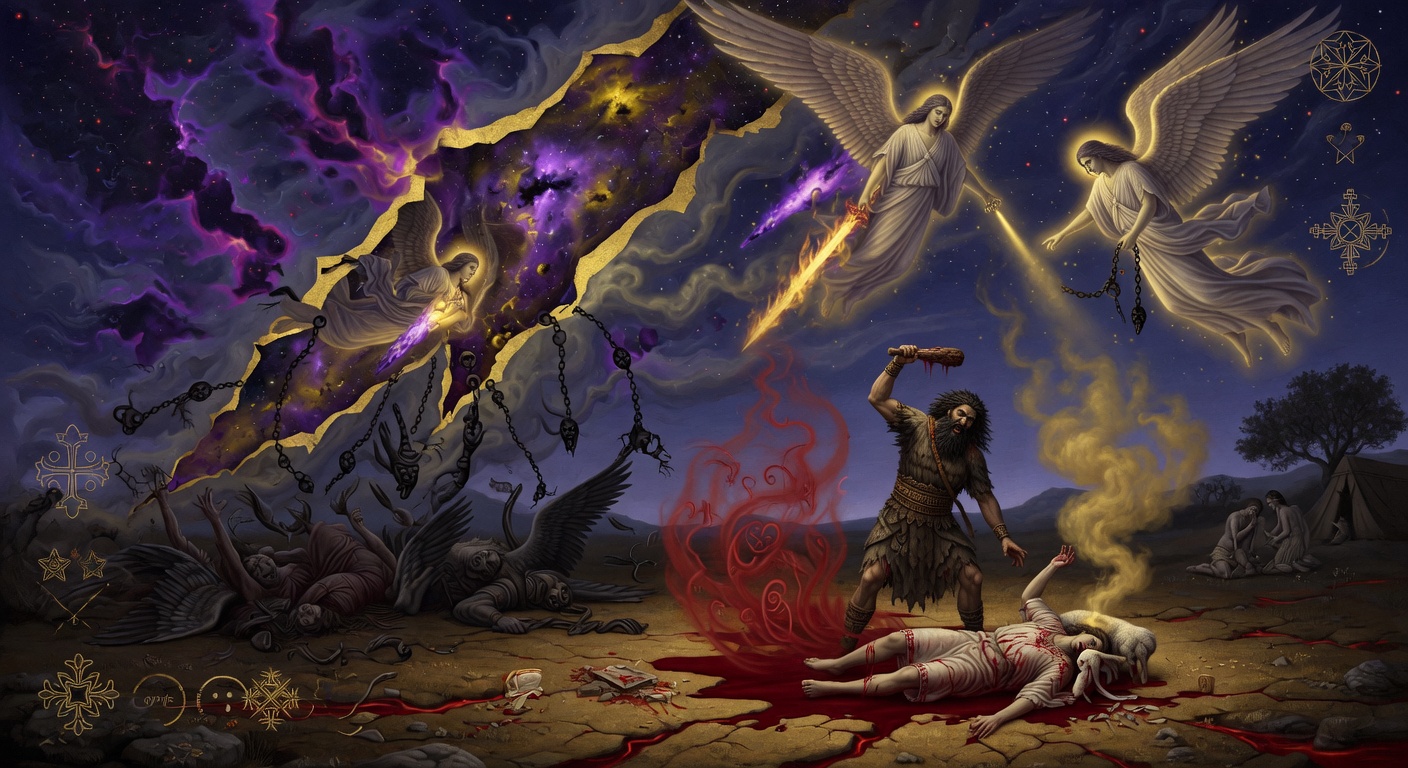
The Murder of Abel by his brother Cain is the first act of human violence - a fratricide born from jealousy over offerings that introduces bloodshed into the world and establishes the pattern of the righteous suffering at the hands of the wicked. Jubilees 4 records the murder within its precise jubilee chronology, emphasizing the divine curse upon Cain and the establishment of blood-guilt as a principle. Jasher expands the narrative with extended dialogue revealing Cain's motives and the immediate consequences for the family. In the Enochic tradition, Abel's blood crying from Sheol (1 Enoch 22) demonstrates that divine justice extends beyond death itself. This event represents a critical juncture in the sacred chronology that the Books of Enoch, Jubilees, and Jasher collectively preserve. Within the jubilee framework that Jubilees meticulously tracks, it occupies a precise position in the divine timetable - not an accident of history but a predetermined turning point inscribed on the heavenly tablets before creation. The expanded narratives in Jasher and the theological interpretations in Jubilees together provide a multidimensional understanding of this moment that illuminates both its immediate consequences and its role in the larger pattern of divine action spanning from creation to final judgment.
Did You Know?
Abel's blood still cries out from Sheol in Enoch's vision (1 Enoch 22) - the dead retain awareness.
Cain's punishment introduces the concept of wandering exile that will recur throughout the tradition.
Jubilees frames the murder within exact chronological dating, making it historically locatable.
The offering dispute suggests worship practices existed from the earliest human generation.
Jasher provides dialogue between the brothers absent from other sources.
Key Passage
Murder of Abel
The Book of Jubilees 4:1-6
And in the third week in the second jubilee 64-70 A.M. she gave birth to Cain, and in the fourth 71-77 A.M. she gave bir...
 1nd in the third week in the second jubilee 64-70 A.M. she gave birth to Cain, and in the fourth 71-77 A.M. she gave birth to Abel, and in the fifth 78-84 A.M. she gave birth to her daughter Âwân.
Did You Know?
Abel's blood still cries out from Sheol in Enoch's vision (1 Enoch 22) - the dead retain awareness.
Cain's punishment introduces the concept of wandering exile that will recur throughout the tradition.
Jubilees frames the murder within exact chronological dating, making it historically locatable.
The offering dispute suggests worship practices existed from the earliest human generation.
Jasher provides dialogue between the brothers absent from other sources.