Babel / Shinar
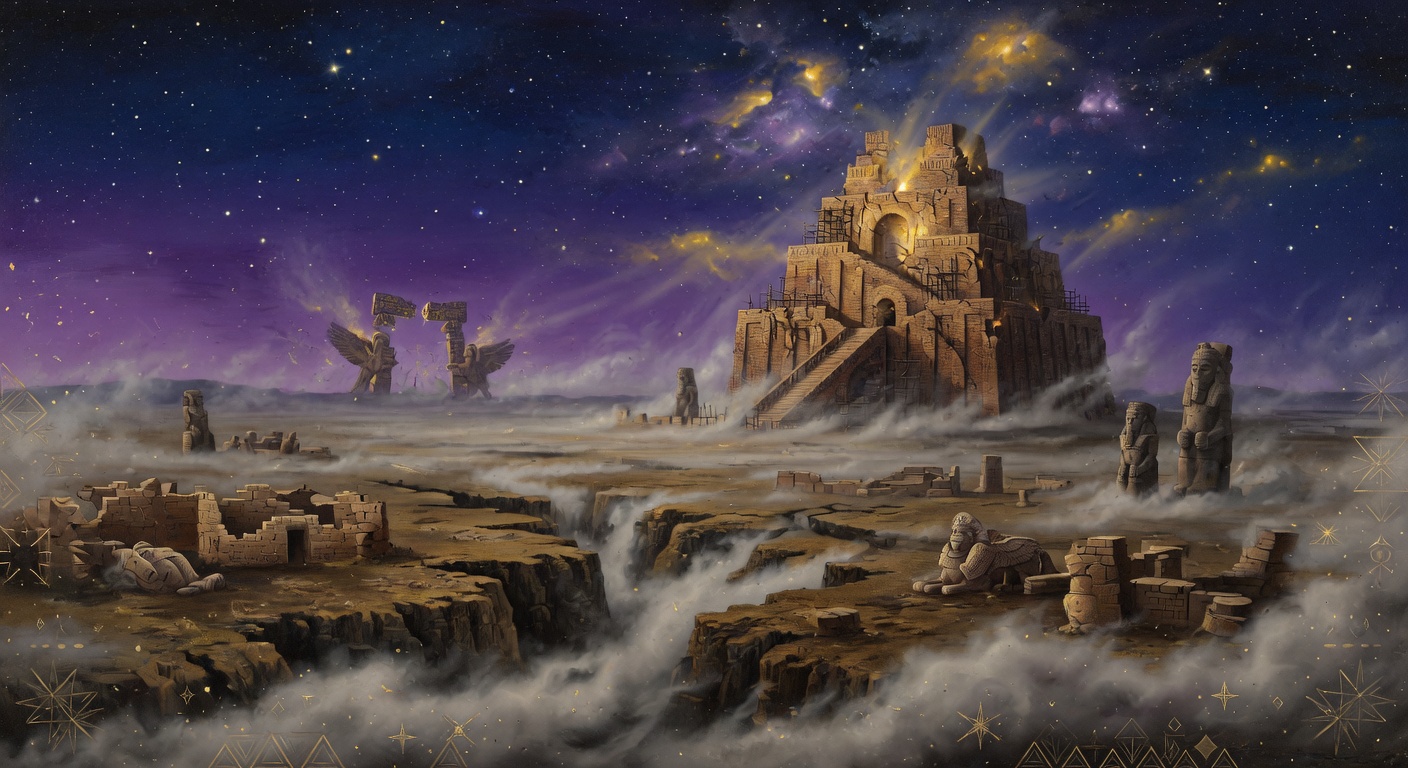
Babel is the city and tower built under Nimrod's direction in the plain of Shinar - a monument of post-flood human rebellion that provoked divine intervention through the confusion of languages. In the generations following the great deluge, the land of Shinar emerges within these ancient writings as a pivotal arena where humanity sought to consolidate power and defy the divine order established after the flood. The Book of Jubilees recounts how the descendants of Noah, led by ambitious figures, migrated to this plain and resolved to construct a towering edifice that would serve as both a monument to their unity and a means to ascend toward the heavens. This endeavor, detailed in Jubilees 10:18-27, arises amid the redistribution of territories among Noah's sons, highlighting Shinar as a contested space where human ambition intersects with the lingering influences of pre-flood corruption. Central to this narrative stands Nimrod, portrayed across the texts as a mighty hunter and ruler whose dominion extends over these regions. The Book of Jasher expands on his role in chapters 7 through 9, describing how he rallied the people to erect the structure using baked bricks and bitumen, explicitly framing the project as an act of rebellion against the Most High to avoid another scattering or judgment. Within the Enochian tradition, such events resonate with the earlier accounts of the Watchers' transgression in 1 Enoch 6-16, where celestial beings imparted forbidden knowledge that fostered pride and technological overreach among humanity, suggesting a continuity of rebellious impulses from angelic descent to post-flood human enterprise. The significance of this locale extends beyond mere geography, embodying the tension between collective human striving and divine sovereignty. The confusion of languages that halts the construction, as elaborated in Jubilees, marks a pivotal moment of fragmentation, dispersing peoples and seeding the rise of distinct nations. This outcome parallels the binding of wayward spirits in Enoch's visions, underscoring themes of order restored through heavenly intervention and the limits imposed on unchecked expansion. Scholars examining these apocryphal works find in Shinar a symbolic nexus linking the flood's aftermath to the broader cosmic struggles depicted in Enoch, where earthly rebellions echo heavenly ones and set the stage for subsequent patriarchal histories.
Details
- Region
- Earth
Journey Paths
Key Chapters
Key Passages
Tower of Babel
The Book of Jasher 9:20-40
And king Nimrod reigned securely, and all the earth was under his control, and all the earth was of one tongue and words...
 20nd king Nimrod reigned securely, and all the earth was under his control, and all the earth was of one tongue and words of union.
Tower of Babel in Jubilees
The Book of Jubilees 10:18-27
And in the three and thirtieth jubilee, in the first year in the second week, Peleg took to himself a wife, whose name w...
18nd in the three and thirtieth jubilee, in the first year in the second week, Peleg took to himself a wife, whose name was Lomna the daughter of Sina'ar, and she bare him a son in the fourth year of this week, and he called his name Reu; for he said: 'Behold the children of men have become evil through the wicked purpose of building for themselves a city and a tower in the land of Shinar.'
Did You Know?
The city and tower built in rebellion under Nimrod in the land of Shinar.
The place where languages were confused and nations were scattered (Jasher).
The builders use baked brick and bitumen - advanced technology deployed against divine purpose.
Confusion of languages is divine counter-strategy - fragmenting unified human rebellion.
Nimrod's ambition here parallels the Watchers' ambition on Hermon - earth echoing heaven's rebellion.