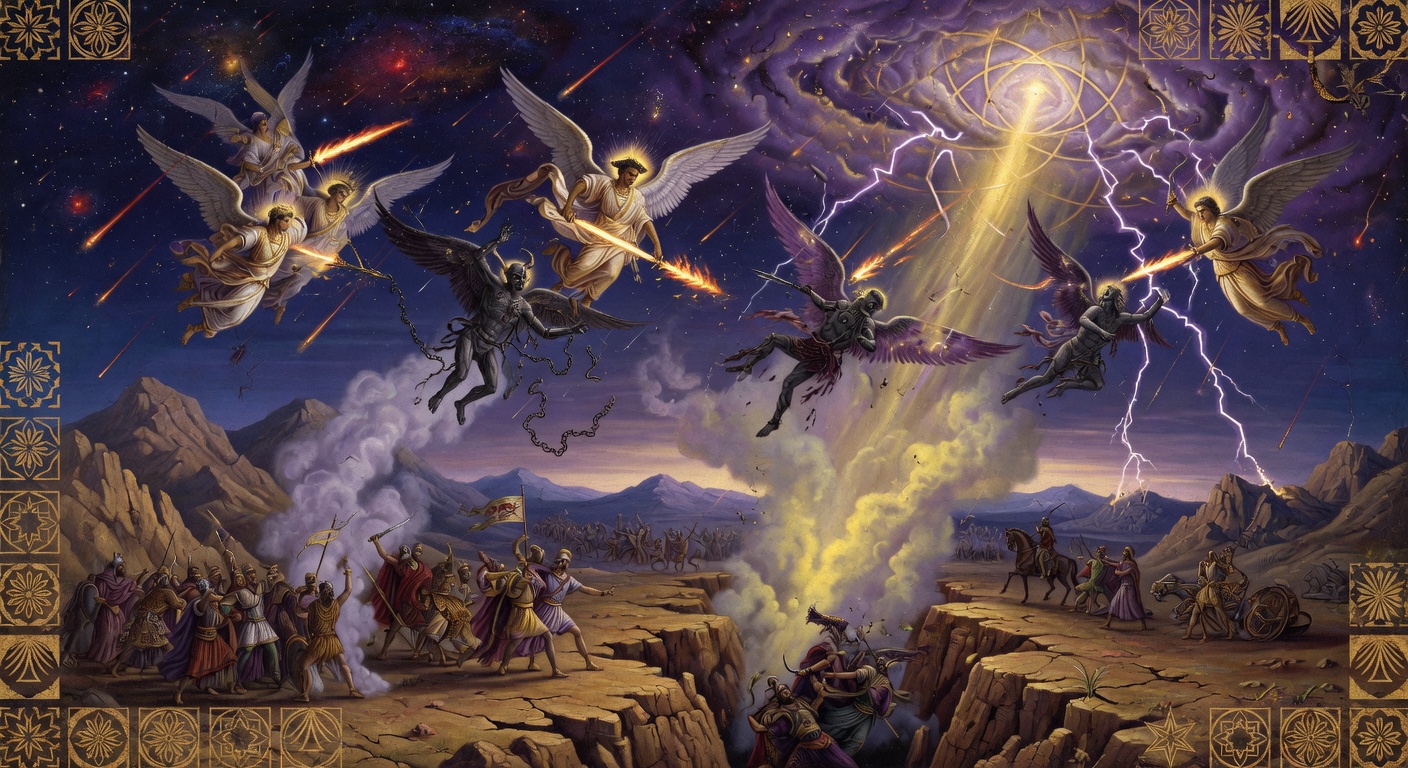
The War between Esau and Jacob is the armed conflict that erupted after Isaac's death when Esau assembled forces from Edom and surrounding nations to seize Canaan from Jacob's household.
In the wake of Isaac's death, longstanding frictions between his sons over birthright and blessing ignite into armed confrontation, a pivotal episode preserved in the pseudepigraphal traditions that expand upon Genesis. These accounts portray the conflict not merely as a family quarrel but as a struggle over covenantal inheritance, with Esau's Edomite descendants arrayed against Jacob's household. The narratives underscore themes of divine election and protection that resonate across Second Temple literature, illustrating how ancestral rivalries prefigure later national hostilities between Israel and its neighbors.
The Book of Jubilees provides the most structured retelling, placing the war in chapters 37 and 38. After Isaac's burial, Esau, influenced by his sons and the bitter memory of losing the blessing, assembles forces from Edom, Moab, and surrounding peoples to seize Canaan by force. Jubilees emphasizes Esau's oath-breaking and moral decline, contrasting it with Jacob's restraint; the ensuing battle sees Jacob's sons, particularly Judah, repel the invaders. Esau himself falls to Judah's arrow, fulfilling earlier patriarchal curses and securing Jacob's line in the land without direct angelic intervention, though the text implies providential oversight through the patriarch's prayers and the sons' unity.
A parallel expansion appears in the Book of Jasher, especially chapters 56 and 57, which supplies tactical details of the campaign, including sieges and individual combats that heighten the drama of familial betrayal. Here the conflict extends beyond Esau's immediate challenge to involve his grandsons, reinforcing the generational stakes. Within the broader Enochic and Jubilean corpus, this episode functions as an etiological explanation for enduring enmity with Edom while echoing Enoch's own visions of cosmic judgment on rebellious powers. It thus bridges patriarchal history with apocalyptic expectations, reminding readers that fidelity to the covenant brings deliverance even amid overwhelming odds.
And in the one hundred and fifth year of the life of Jacob, that is the ninth year of Jacob's dwelling with his children...
A1nd in the one hundred and fifth year of the life of Jacob, that is the ninth year of Jacob's dwelling with his children in the land of Canaan, he came from Padan-aram.
2 And in those days Jacob journeyed with his children from Hebron, and they went and returned to the city of Shechem, they and all belonging to them, and they dwelt there, for the children of Jacob obtained good and fat pasture land for their cattle in the city of Shechem, the city of Shechem having then been rebuilt, and there were in it about three hundred men and women.3 And Jacob and his children and all belonging to him dwelt in the part of the field which Jacob had bought from Hamor the father of Shechem, when he came from Padan-aram before Simeon and Levi had smitten the city.4 And all those kings of the Canaanites and Amorites that surrounded the city of Shechem, heard that the sons of Jacob had again come to Shechem and dwelt there.5 And they said, Shall the sons of Jacob the Hebrew again come to the city and dwell therein, after that they have smitten its inhabitants and driven them out? shall they now return and also drive out those who are dwelling in the city or slay them?6 And all the kings of Canaan again assembled, and they came together to make war with Jacob and his sons.7 And Jashub king of Tapnach sent also to all his neighboring kings, to Elan king of Gaash, and to Ihuri king of Shiloh, and to Parathon king of Chazar, and to Susi king of Sarton, and to Laban king of Bethchoran, and to Shabir king of Othnay-mah, saying,8 Come up to me and assist me, and let us smite Jacob the Hebrew and his sons, and all belonging to him, for they are again come to Shechem to possess it and to slay its inhabitants as before.9 And all these kings assembled together and came with all their camps, a people exceedingly plentiful like the sand upon the sea shore, and they were all opposite to Tapnach.10 And Jashub king of Tapnach went forth to them with all his army, and he encamped with them opposite to Tapnach without the city, and all these kings they divided into seven divisions, being seven camps against the sons of Jacob.11 And they sent a declaration to Jacob and his son, saying, Come you all forth to us that we may have an interview together in the plain, and revenge the cause of the men of Shechem whom you slew in their city, and you will now again return to the city of Shechem and dwell therein, and slay its inhabitants as before.12 And the sons of Jacob heard this and their anger was kindled exceedingly at the words of the kings of Canaan, and ten of the sons of Jacob hastened and rose up, and each of them girt on his weapons of war; and there were one hundred and two of their servants with them equipped in battle array.13 And all these men, the sons of Jacob with their servants, went toward these kings, and Jacob their father was with them, and they all stood upon the heap of Shechem.14 And Jacob prayed to the Lord for his sons, and he spread forth his hands to the Lord, and he said, O God, thou art an Almighty God, thou art our father, thou didst form us and we are the works of thine hands; I pray thee deliver my sons through thy mercy from the hand of their enemies, who are this day coming to fight with them and save them from their hand, for in thy hand is power and might, to save the few from the many.15 And give unto my sons, thy servants, strength of heart and might to fight with their enemies, to subdue them, and make their enemies fall before them, and let not my sons and their servants die through the hands of the children of Canaan.16 But if it seemeth good in thine eyes to take away the lives of my sons and their servants, take them in thy great mercy through the hands of thy ministers, that they may not perish this day by the hands of the kings of the Amorites.17 And when Jacob ceased praying to the Lord the earth shook from its place, and the sun darkened, and all these kings were terrified and a great consternation seized them.18 And the Lord hearkened to the prayer of Jacob, and the Lord impressed the hearts of all the kings and their hosts with the terror and awe of the sons of Jacob.19 For the Lord caused them to hear the voice of chariots, and the voice of mighty horses from the sons of Jacob, and the voice of a great army accompanying them.20 And these kings were seized with great terror at the sons of Jacob, and whilst they were standing in their quarters, behold the sons of Jacob advanced upon them, with one hundred and twelve men, with a great and tremendous shouting.21 And when the kings saw the sons of Jacob advancing toward them, they were still more panic struck, and they were inclined to retreat from before the sons of Jacob as at first, and not to fight with them.22 But they did not retreat, saying, It would be a disgrace to us thus twice to retreat from before the Hebrews.23 And the sons of Jacob came near and advanced against all these kings and their armies, and they saw, and behold it was a very mighty people, numerous as the sand of the sea.24 And the sons of Jacob called unto the Lord and said, Help us O Lord, help us and answer us, for we trust in thee, and let us not die by the hands of these uncircumcised men, who this day have come against us.25 And the sons of Jacob girt on their weapons of war, and they took in their hands each man his shield and his javelin, and they approached to battle.26 And Judah, the son of Jacob, ran first before his brethren, and ten of his servants with him, and he went toward these kings.27 And Jashub, king of Tapnach, also came forth first with his army before Judah, and Judah saw Jashub and his army coming toward him, and Judah's wrath was kindled, and his anger burned within him, and he approached to battle in which Judah ventured his life.28 And Jashub and all his army were advancing toward Judah, and he was riding upon a very strong and powerful horse, and Jashub was a very valiant man, and covered with iron and brass from head to foot.29 And whilst he was upon the horse, he shot arrows with both hands from before and behind, as was his manner in all his battles, and he never missed the place to which he aimed his arrows.30 And when Jashub came to fight with Judah, and was darting many arrows against Judah, the Lord bound the hand of Jashub, and all the arrows that he shot rebounded upon his own men.
And Jacob lived in the land of Egypt seventeen years, and the days of Jacob, and the years of his life were a hundred an...
A1nd Jacob lived in the land of Egypt seventeen years, and the days of Jacob, and the years of his life were a hundred and forty seven years.
2 At that time Jacob was attacked with that illness of which he died and he sent and called for his son Joseph from Egypt, and Joseph his son came from Egypt and Joseph came unto his father.3 And Jacob said unto Joseph and unto his sons, Behold I die, and the God of your ancestors will visit you, and bring you back to the land, which the Lord sware to give unto you and unto your children after you, now therefore when I am dead, bury me in the cave which is in Machpelah in Hebron in the land of Canaan, near my ancestors.4 And Jacob made his sons swear to bury him in Machpelah, in Hebron, and his sons swore unto him concerning this thing.5 And he commanded them, saying, Serve the Lord your God, for he who delivered your fathers will also deliver you from all trouble.6 And Jacob said, Call all your children unto me, and all the children of Jacob's sons came and sat before him, and Jacob blessed them, and he said unto them, The Lord God of your fathers shall grant you a thousand times as much and bless you, and may he give you the blessing of your father Abraham; and all the children of Jacob's sons went forth on that day after he had blessed them.7 And on the next day Jacob again called for his sons, and they all assembled and came to him and sat before him, and Jacob on that day blessed his sons before his death, each man did he bless according to his blessing; behold it is written in the book of the law of the Lord appertaining to Israel.8 And Jacob said unto Judah, I know my son that thou art a mighty man for thy brethren; reign over them, and thy sons shall reign over their sons forever.9 Only teach thy sons the bow and all the weapons of war, in order that they may fight the battles of their brother who will rule over his enemies.10 And Jacob again commanded his sons on that day, saying, Behold I shall be this day gathered unto my people; carry me up from Egypt, and bury me in the cave of Machpelah as I have commanded you.11 Howbeit take heed I pray you that none of your sons carry me, only yourselves, and this is the manner you shall do unto me, when you carry my body to go with it to the land of Canaan to bury me,12 Judah, Issachar and Zebulun shall carry my bier at the eastern side; Reuben, Simeon and Gad at the south, Ephraim, Manasseh and Benjamin at the west, Dan, Asher and Naphtali at the north.13 Let not Levi carry with you, for he and his sons will carry the ark of the covenant of the Lord with the Israelites in the camp, neither let Joseph my son carry, for as a king so let his glory be; howbeit, Ephraim and Manasseh shall be in their stead.14 Thus shall you do unto me when you carry me away; do not neglect any thing of all that I command you; and it shall come to pass when you do this unto me, that the Lord will remember you favorably and your children after you forever.15 And you my sons, honor each his brother and his relative, and command your children and your children's children after you to serve the Lord God of your ancestors all the days.16 In order that you may prolong your days in the land, you and your children and your children's children for ever, when you do what is good and upright in the sight of the Lord your God, to go in all his ways.17 And thou, Joseph my son, forgive I pray thee the prongs of thy brethren and all their misdeeds in the injury that they heaped upon thee, for God intended it for thine and thy children's benefit.18 And O my son leave not thy brethren to the inhabitants of Egypt, neither hurt their feelings, for behold I consign them to the hand of God and in thy hand to guard them from the Egyptians; and the sons of Jacob answered their father saying, O, our father, all that thou hast commanded us, so will we do; may God only be with us.19 And Jacob said unto his sons, So may God be with you when you keep all his ways; turn not from his ways either to the right or the left in performing what is good and upright in his sight.20 For I know that many and grievous troubles will befall you in the latter days in the land, yea your children and children's children, only serve the Lord and he will save you from all trouble.21 And it shall come to pass when you shall go after God to serve him and will teach your children after you, and your children's children, to know the Lord, then will the Lord raise up unto you and your children a servant from amongst your children, and the Lord will deliver you through his hand from all affliction, and bring you out of Egypt and bring you back to the land of your fathers to inherit it securely.22 And Jacob ceased commanding his sons, and he drew his feet into the bed, he died and was gathered to his people.23 And Joseph fell upon his father and he cried out and wept over him and he kissed him, and he called out in a bitter voice, and he said, O my father, my father.24 And his son's wives and all his household came and fell upon Jacob, and they wept over him, and cried in a very loud voice concerning Jacob.25 And all the sons of Jacob rose up together, and they tore their garments, and they all put sackcloth upon their loins, and they fell upon their faces, and they cast dust upon their heads toward the heavens.26 And the thing was told unto Osnath Joseph's wife, and she rose up and put on a sack and she with all the Egyptian women with her came and mourned and wept for Jacob.27 And also all the people of Egypt who knew Jacob came all on that day when they heard this thing, and all Egypt wept for many days.28 And also from the land of Canaan did the women come unto Egypt when they heard that Jacob was dead, and they wept for him in Egypt for seventy days.29 And it came to pass after this that Joseph commanded his servants the doctors to embalm his father with myrrh and frankincense and all manner of incense and perfume, and the doctors embalmed Jacob as Joseph had commanded them.30 And all the people of Egypt and the elders and all the inhabitants of the land of Goshen wept and mourned over Jacob, and all his sons and the children of his household lamented and mourned over their father Jacob many days.
And Ihuri king of Shiloh came up to assist Elon, and he approached Jacob, when Jacob drew his bow that was in his hand a...
A1nd Ihuri king of Shiloh came up to assist Elon, and he approached Jacob, when Jacob drew his bow that was in his hand and with an arrow struck Ihuri which caused his death.
2 And when Ihuri king of Shiloh was dead, the four remaining kings fled from their station with the rest of the captains, and they endeavored to retreat, saying, We have no more strength with the Hebrews after their having killed the three kings and their captains who were more powerful than we are.3 And when the sons of Jacob saw that the remaining kings had removed from their station, they pursued them, and Jacob also came from the heap of Shechem from the place where he was standing, and they went after the kings and they approached them with their servants.4 And the kings and the captains with the rest of their armies, seeing that the sons of Jacob approached them, were afraid of their lives and fled till they reached the city of Chazar.5 And the sons of Jacob pursued them to the gate of the city of Chazar, and they smote a great smiting amongst the kings and their armies, about four thousand men, and whilst they were smiting the army of the kings, Jacob was occupied with his bow confining himself to smiting the kings, and he slew them all.6 And he slew Parathon king of Chazar at the gate of the city of Chazar, and he afterward smote Susi king of Sarton, and Laban king of Bethchorin, and Shabir king of Machnaymah, and he slew them all with arrows, an arrow to each of them, and they died.7 And the sons of Jacob seeing that all the kings were dead and that they were broken up and retreating, continued to carry on the battle with the armies of the kings opposite the gate of Chazar, and they still smote about four hundred of their men.8 And three men of the servants of Jacob fell in that battle, and when Judah saw that three of his servants had died, it grieved him greatly, and his anger burned within him against the Amorites.9 And all the men that remained of the armies of the kings were greatly afraid of their lives, and they ran and broke the gate of the walls of the city of Chazar, and they all entered the city for safety.10 And they concealed themselves in the midst of the city of Chazar, for the city of Chazar was very large and extensive, and when all these armies had entered the city, the sons of Jacob ran after them to the city.11 And four mighty men, experienced in battle, went forth from the city and stood against the entrance of the city, with drawn swords and spears in their hands, and they placed themselves opposite the sons of Jacob, and would not suffer them to enter the city.12 And Naphtali ran and came between them and with his sword smote two of them, and cut off their heads at one stroke.13 And he turned to the other two, and behold they had fled, and he pursued them, overtook them, smote them and slew them.14 And the sons of Jacob came to the city and saw, and behold there was another wall to the city, and they sought for the gate of the wall and could not find it, and Judah sprang upon the top of the wall, and Simeon and Levi followed him, and they all three descended from the wall into the city.15 And Simeon and Levi slew all the men who ran for safety into the city, and also the inhabitants of the city with their wives and little ones, they slew with the edge of the sword, and the cries of the city ascended up to heaven.
 1nd in the one hundred and fifth year of the life of Jacob, that is the ninth year of Jacob's dwelling with his children in the land of Canaan, he came from Padan-aram.