Enoch's Heavenly Visions
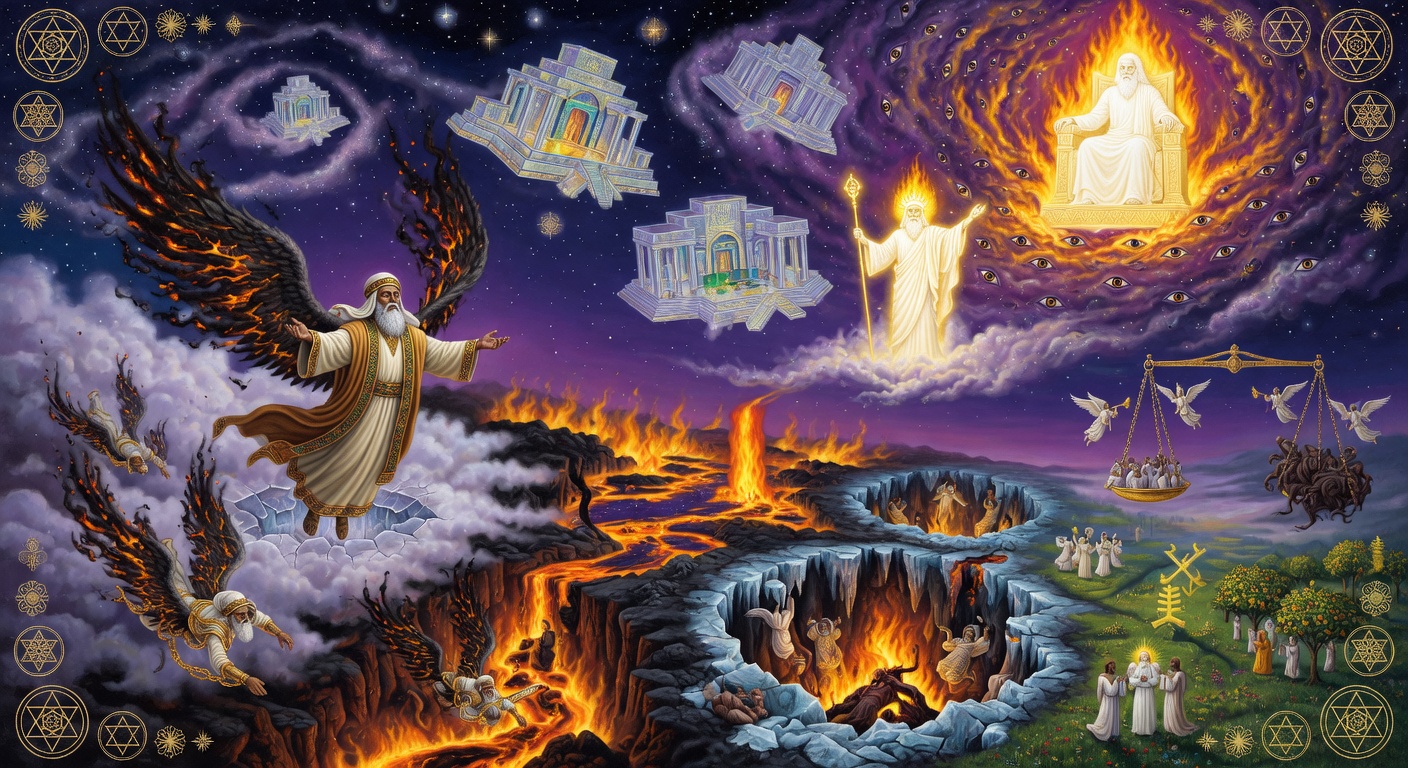
Enoch's Heavenly Visions are the series of supernatural revelations granted to the patriarch during his ascents through the celestial realms - encompassing throne-room encounters, cosmic tours, and the complete history of the world in allegorical form. Among the ancient Jewish apocalyptic writings attributed to the patriarch Enoch, the accounts of his visionary experiences stand as some of the most profound explorations of divine realms and eschatological mysteries preserved from the Second Temple period. These narratives, woven primarily through the Book of Watchers and the Similitudes, portray Enoch as a seer granted access to heavenly secrets that illuminate the origins of evil and the structure of cosmic judgment. Drawing from traditions that likely circulated between the third and first centuries BCE, the visions emphasize Enoch's role as an intermediary who witnesses events inaccessible to ordinary humanity, thereby establishing a framework for understanding divine justice that influenced later apocalyptic literature. Central to these accounts are the detailed depictions of the Watchers' rebellion and its consequences, as recounted in chapters 6 through 16 of 1 Enoch. Enoch is transported through layered heavens, where he beholds the throne of glory surrounded by fiery attendants and streams of flame, an image that underscores the inaccessibility and majesty of the divine presence. His journeys extend to remote regions of the earth and underworld, revealing the places prepared for the punishment of fallen angels and the reward of the righteous, themes that recur across chapters 17 to 36. These travels serve not merely as spectacle but as revelations that connect primordial transgressions to ongoing human suffering, grounding moral order in observable cosmic realities. The visions reach their theological climax in portrayals of the Son of Man, particularly within the Similitudes, where this figure appears as a preexistent agent of judgment seated beside the Ancient of Days. Enoch himself is at times identified with this exalted being, highlighting the fluid boundaries between human and divine in these traditions. Scenes of final judgment, including the weighing of souls and the separation of the wicked into places of torment, provide a comprehensive eschatological vision that integrates personal accountability with universal renewal. Within the broader Enochian corpus, these heavenly experiences function as the interpretive core, offering readers a lens through which to view history as a drama unfolding under divine oversight and inviting contemplation of humanity's place within an ordered yet contested cosmos.
Details
- Category
- Apocalyptic
- Prayed by
- Enoch
Key Chapters
Key Passages
First Visions and Ascent
The Book of Enoch 14:1-25
The book of the words of righteousness, and of the reprimand of the eternal Watchers in accordance with the command of t...
 1he book of the words of righteousness, and of the reprimand of the eternal Watchers in accordance with the command of the Holy Great One in that vision.
Parables of the Son of Man
The Book of Enoch 37:1-5
The second vision which he saw, the vision of wisdom -which Enoch the son of Jared, the son of Mahalalel, the son of Cai...
1he second vision which he saw, the vision of wisdom -which Enoch the son of Jared, the son of Mahalalel, the son of Cainan, the son of Enos, the son of Seth, the son of Adam, saw.
The Animal Apocalypse begins
The Book of Enoch 85:1-10
And after this I saw another dream, and I will show the whole dream to thee, my son....
 1nd after this I saw another dream, and I will show the whole dream to thee, my son.
Vision of the seventy shepherds
The Book of Enoch 89:59-77
And He called seventy shepherds, and cast those sheep to them that they might pasture them, and He spake to the shepherd...
59nd He called seventy shepherds, and cast those sheep to them that they might pasture them, and He spake to the shepherds and their companions: ' Let each individual of you pasture the sheep henceforward, and everything that I shall command you that do ye.
The Apocalypse of Weeks
The Book of Enoch 93:1-10
And after that Enoch both gave and began to recount from the books....
1nd after that Enoch both gave and began to recount from the books.
Enoch's first dream of the flood
The Book of Enoch 83:1-11
And now, my son Methuselah, I will show thee all my visions which I have seen, recounting them before thee....
1nd now, my son Methuselah, I will show thee all my visions which I have seen, recounting them before thee.
Punishment of fallen angels
The Book of Enoch 88:1-3
And I saw one of those four who had come forth first, and he seized that first star which had fallen from the heaven, an...
1nd I saw one of those four who had come forth first, and he seized that first star which had fallen from the heaven, and bound it hand and foot and cast it into an abyss: now that abyss was narrow and deep, and horrible and dark.
Introduction to Epistle
The Book of Enoch 92:1-5
The book written by Enoch-Enoch indeed wrote this complete doctrine of wisdom, (which is) praised of all men and a judge...
1he book written by Enoch-Enoch indeed wrote this complete doctrine of wisdom, (which is) praised of all men and a judge of all the earth for all my children who shall dwell on the earth. And for the future generations who shall observe uprightness and peace.
Did You Know?
Enoch's journeys cover the entire cosmos and the secrets of its operation.
The Parables section (chs 37-71) is unique to the Ethiopic version.
Enoch's throne vision in chapter 14 is the earliest known Jewish merkabah (chariot-throne) mysticism text.
The Animal Apocalypse encodes the entire history of Israel using animal symbols - bulls, sheep, and birds.
The Apocalypse of Weeks divides all history into ten 'weeks' of varying length, each with a defining event.
Enoch sees both past and future simultaneously from the heavenly vantage point, collapsing time.
The dream visions serve as the interpretive framework for understanding why the flood was necessary.