Post-Flood to Abraham
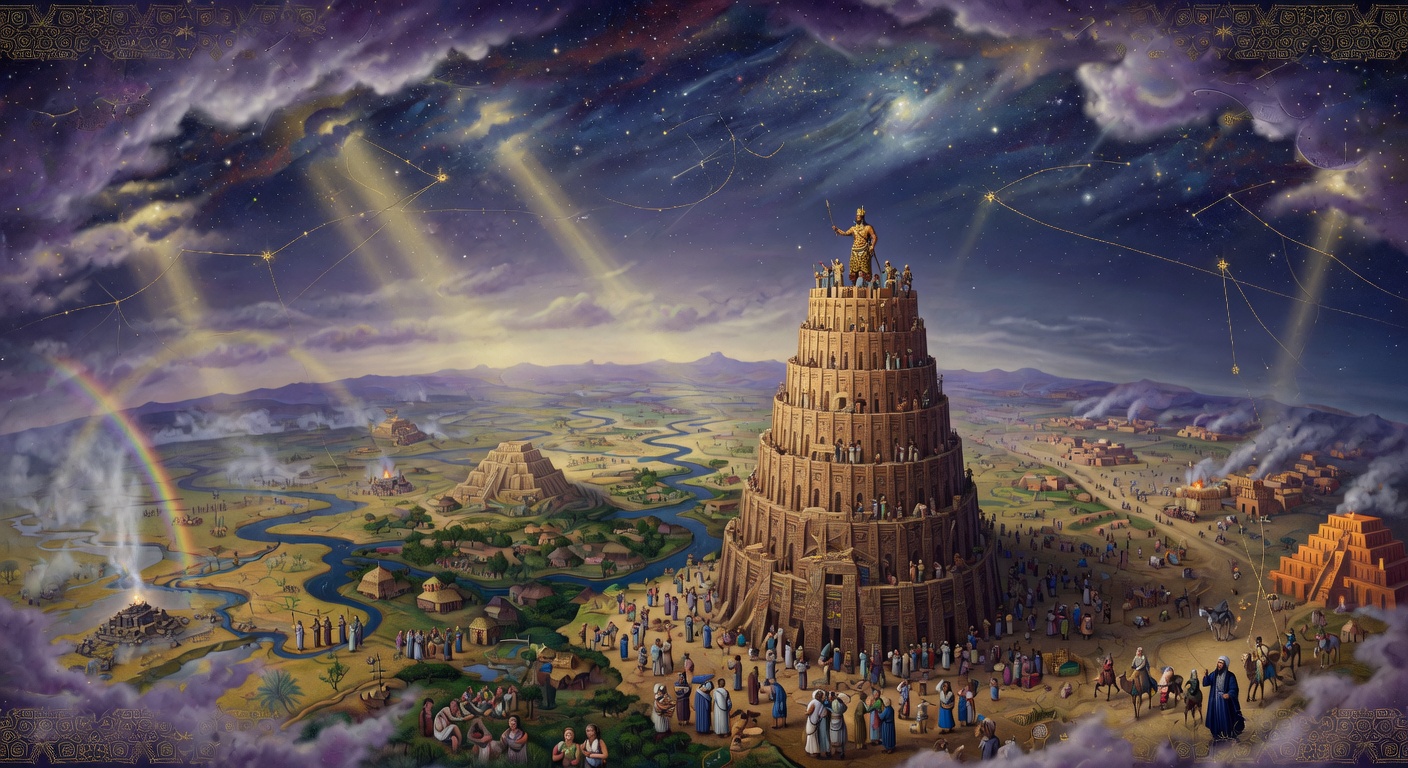
The Post-Flood Era covers the renewal of the world under Noah's covenant through the rise of nations - including the division of the earth among Noah's sons, Nimrod's rebellion at Babel, and the spread of idolatry. Following the great deluge that cleansed the earth, the ancient texts portray a period of renewal and divine reordering centered on Noah and his descendants. In the Book of Jubilees, this era opens with the renewal of the covenant at Mount Sinai's precursor, where Noah receives explicit instructions on blood prohibitions and the observance of festivals, sealed by the rainbow as an eternal sign (Jubilees 6:1-17). This covenant not only restores moral order but also establishes the sacred calendar inherited from Enoch, ensuring that the post-flood generations maintain harmony with heavenly rhythms amid a world still shadowed by the lingering influence of the Watchers. The division of the earth among Noah's three sons further defines this age as one of structured inheritance and emerging tensions. Jubilees chapters 8 and 9 meticulously map the allotments-Shem receiving the central and blessed portions including the Garden of Eden's vicinity, Ham the southern regions, and Japheth the northern expanses-while warning against future encroachments that would violate these boundaries. The Book of Jasher echoes this apportionment, noting how these divisions foster distinct lineages yet plant seeds for conflict, as the sons navigate a landscape marked by both divine favor and the potential for rebellion. Central to the narrative's drama is the rise of Nimrod and the construction of the Tower of Babel, events that precipitate the scattering of nations. Jubilees 10 describes how Mastema incites humanity's unified defiance, leading to the confusion of tongues and dispersal from Shinar, while Jasher elaborates on Nimrod's tyrannical rule and the tower's ambitious design as a challenge to divine authority. These upheavals fragment the unified post-flood world, yet they also preserve a remnant of sacred knowledge through select lineages. This scattering ultimately directs the account toward Terah and his son Abraham, framing the era as a bridge between primordial revelation and the patriarchal promises. In Jubilees 11-12, Abraham emerges amid Chaldean idolatry, rediscovering Enochic wisdom and rejecting false gods, thus positioning the post-flood generations as custodians of a covenantal thread that will extend through Israel.
Did You Know?
Jubilees divides the entire earth among Noah's three sons by lot and divine oath.
Nimrod's rise in this period mirrors the Watchers' rebellion - human ambition echoing angelic pride.
Jubilees divides the entire earth among Noah's three sons by sacred lot and mutual oath.
Canaan's illegal seizure of Shem's territory sets up the entire later conflict over the promised land.
Nimrod's tower-building echoes the Watchers' ambition - human pride repeating angelic rebellion.